Technical guide · Press systems and joining methods
Press systems and joining methods: systems, system finder, comparison and calculator
Press, push-fit, groove, weld, thread, flange or solder – which joint a pipeline gets decides assembly time, fire protection, testing effort and whether it can be opened again later. This pillar places the press, push-fit and coupling systems we carry as a contract dealer of Viega, Sanha, Geberit, GF and Victaulic across manufacturers: by medium, pipe material, size, sealing element and availability. And it says when a press system replaces the weld seam – and when not.
- Methods
- press · push-fit · grooved/coupling · welding · thread · flange · soldering
- Manufacturers (contract dealer)
- Viega · Sanha · Geberit · GF · Victaulic
- Pipes
- copper EN 1057 · stainless steel · carbon steel · multilayer and polybutene · thick-walled steel pipe EN 10255 / EN 10220
- Sizes
- 12–168.3 mm · ⅜–4 inch (Megapress) · up to 24 inch (grooved coupling)
- Availability
- from stock or to order – per system in the overview
Three tools for the decision
The manufacturers explain their systems well – each its own. What is missing is the view across the brands, with the availability from one warehouse that carries them all. For that, three tools stand here, all calculated from the same data layer:
Tool
System finder
Choose medium, pipe material and size – the result names the approved systems with sealing element, pressure and temperature limit, profile note and availability from us. Plus the decision table application × system to print.
Tool
Joining methods comparison
Seven methods, ten criteria: hot work, qualification, testing, tooling, size, detachability, suitability in existing plant, codes – every cell with its origin (manufacturer, code, trade experience).
Tool
Cost comparison calculator
Assembly time, cost and downtime per method – with two inputs as a time comparison, with your hourly rate as a cost comparison; assembly times preset as rough guide values and editable. With a worked example. A model, not an offer.
What a press system is – and why it always has four parts
A press joint connects pipe and fitting by controlled mechanical deformation: a press connector with an inserted sealing element is permanently pressed onto the pipe with a press tool – cold, without open flame, in seconds, and immediately loadable. The word system is not advertising here but the boundary of the approval: pipe, connector, sealing element and tool with its press profile are tested and approved together. Whoever exchanges one of them leaves the approval – even if it fits visually.
- Pipe: system pipe in copper (EN 1057), stainless steel (1.4401, 1.4404, 1.4521, 1.4520), galvanised carbon steel, multilayer composite or polybutene – calibrated and named by the manufacturer for the system. The exception is Megapress: it presses the thick-walled, inch-size steel pipe of pipeline construction.
- Connector: elbow, tee, socket, reducer, adapter to thread or flange – in copper, gunmetal, silicon bronze, stainless steel, carbon steel, PPSU or zinc-nickel-coated steel.
- Sealing element: an elastomer ring in the bead of the connector whose material decides the medium (see below). Raxofix seals without O-ring via a support body; push-fit systems such as GF iFIT via O-rings in the push-fit fitting.
- Tool and profile: press tool with press jaw or press ring in the profile for which the connector is approved. Visually similar profiles must never be mixed – one of the most frequent errors in practice.
Radial, “raxial”, lateral, push-fit
In radial pressing (Profipress, Sanpress, NiroSan, Mepla, Megapress) the jaw deforms connector and sealing element all round onto the pipe. Viega Raxofix converts the radial tool movement into an axial press – without O-ring, without calibrating and expanding. Geberit FlowFit presses laterally with two press jaws and shows the press through a coloured press indicator. Push-fit systems such as GF iFIT need no press tool at all: the pipe is pushed in up to the mark and is held by grip ring and O-ring. The grooved coupling (Victaulic) is not a press system but belongs in the same comparison: it joins grooved steel pipes detachably via a two-piece housing with gasket – from DN 65 the direct competitor to Megapress XL, flange and weld seam.
Unpressed means leaking: SC-Contur and the point of the leak test
The dreaded error of every press installation is the forgotten press: the connector sits, the plant is filled, and the joint holds – until it no longer does. Against this the manufacturers have built in a safety feature: Viega calls it SC-Contur (DVGW-certified), Sanha UVUD (“unpressed means leaking”), Geberit FlowFit works with defined leak paths and a press indicator. What they have in common: a joint that has accidentally not been pressed is necessarily leaking at the leak test – at Viega guaranteed in the range of the wet test at 0.1–0.65 MPa and the dry test at 22 hPa to 0.3 MPa. This presupposes that a test is carried out, namely to the ZVSHK leaflet on leak testing or the manufacturer's specifications; the dry test with air or inert gas allows a plant to be tested before water enters. What the test does not replace: marking and checking the insertion depth, because a pipe inserted too short can be pressed and still not be safe. More on the page Leak testing and SC-Contur.
Sealing elements: the medium decides
Not the connector but the sealing element determines which medium may pass through the line at which temperature. The colour codes help on site, the approval is in the manufacturer's media list:
| Material | Marking | Temperature range | Typical media | Not suitable |
|---|---|---|---|---|
| EPDM | black (Viega, Sanha); green stripe (Victaulic grade E) | −30 to 120 °C (Viega standard 110 °C, Megapress 105 °C) | drinking water, heating and cooling water, oil-free compressed air, technical gases, fire-fighting water | mineral oil and petroleum products, steam |
| HNBR | yellow (gas systems: Profipress G, Sanpress G, Sanpress Inox G, Megapress G, NiroSan Gas) | −20 to 70 °C | natural gas, LPG, hydrogen, technical gases, heating oil and diesel | drinking water |
| FKM | matt black with white dot (Megapress S); red (Sanha HT); blue/white (Geberit) | −20 to 160 °C per system (Megapress S 140 °C) | district heating, solar, low-pressure steam, compressed air with oil, heating oil, high temperatures | drinking water (system-dependent), heating water above the manufacturer's limit |
| CIIR | black (Geberit Mepla) | 0 to 80 °C (Mepla) | drinking water, heating | gas, high temperatures |
| Nitrile (NBR) | orange stripe (Victaulic grade T) | −29 to 82 °C | petroleum products, air with oil vapour, oils | hot water above 66 °C, hot dry air |
The temperature ranges are material figures; per system the narrower limit of the instructions for use applies. Which combination of medium and system is approved is shown by the system finder row by row; background on materials, colour codes and media lists is on the page Sealing elements and media.
The systems we carry – across manufacturers
The overview names every system with pipe, sizes, standard sealing element, pressure and temperature limit and the availability from us: in stock means stock item, available to order means in the item master without stock, available on request means procured through the manufacturer or contract partner. How quickly a size is available we clarify on request. The values come from the manufacturer documents, each with its edition, and follow when range or source changes.
Show full table · more than 20 rows
| System | Pipe | Sizes | Sealing element | Tmax / Pmax | Typical use | Availability |
|---|---|---|---|---|---|---|
| Viega Profipress (copper) | copper pipe EN 1057 | 12–64 mm | EPDM | 105 °C / 16 bar | drinking water, heating/cooling, special media | in stock 12–54; available to order 64 |
| Viega Profipress G (gas) | copper pipe EN 1057 | 12–64 mm | HNBR | 70 °C / 5 bar | gas, special media | available to order 12, 64; in stock 15–54 |
| Viega Profipress S (solar, high temperature) | copper pipe EN 1057 | 12–35 mm | FKM | 140 °C / 16 bar | special media (district heating, solar, compressed air, technical gases) | available on request |
| Viega Sanpress (gunmetal, stainless steel pipe) | stainless steel 1.4401 and 1.4521 | 12–108 mm | EPDM | 105 °C / 16 bar | drinking water | in stock 12–54; available to order 64–108 |
| Viega Sanpress G (gas) | stainless steel 1.4401 | 12–108 mm | HNBR | 70 °C / 5 bar | gas, special media | available to order 12, 64–108; in stock 15–54 |
| Viega Sanpress Inox (stainless steel complete system) | stainless steel 1.4401 and 1.4521 | 15–108 mm | EPDM | 105 °C / 16 bar | drinking water, heating/cooling, special media | in stock 15–54; available to order 64–108 |
| Viega Sanpress Inox G (gas) | stainless steel 1.4401 | 15–108 mm | HNBR | 70 °C / 5 bar | gas (natural gas, LPG, hydrogen), technical gases | in stock 15–28; available to order 35–108 |
| Viega Temponox (stainless steel, heating/cooling) | stainless steel 1.4520 | 15–108 mm | EPDM | 105 °C / 16 bar | heating/cooling (closed circuits), technical gases, compressed air | in stock 15–54; available to order 64–108 |
| Viega Raxofix (multilayer composite pipe) | multilayer composite pipe | 16–63 mm | without O-ring (joining method without sealing element) | 95 °C / 10 bar | drinking water, heating | available to order |
| Viega Megapress (thick-walled steel pipe) | thick-walled steel pipe (black, galvanised, painted) | ⅜–2 inch, XL 2½–4 inch | EPDM | 105 °C / 16 bar | heating/cooling, special media | available on request |
| Viega Megapress S (FKM, higher temperatures) and S XL | thick-walled steel pipe (black, galvanised, painted) | ⅜–2 inch, XL 2½–4 inch | FKM | 140 °C / 16 bar | special media (district heating, solar, compressed air, technical gases) | available on request |
| Viega Megapress G (gas) | thick-walled steel pipe (black, galvanised, painted) | ½–2 inch | HNBR | 70 °C / 5 bar | gas, special media | available on request |
| SANHA NiroSan (stainless steel press system) | stainless steel 1.4404, ferritic 1.4521 | 15–168.3 mm | EPDM | 120 °C / 16 bar | drinking water, heating, compressed air, fire-fighting water, technical gases | in stock 15–54, 108; available to order 64–88.9, 139.7–168.3 |
| SANHA NiroSan Gas | stainless steel 1.4404 (316L) | 15–108 mm | HNBR | 70 °C / 5 bar | gas (natural gas, LPG, hydrogen), technical gases | available on request |
| SANHA NiroSan Industry (FKM, high temperature) | stainless steel 1.4404 (316L) | 15–108 mm | FKM | 160 °C / 16 bar | special media (district heating, solar, compressed air, technical gases) | available on request |
| SANHA-Press (copper) incl. Gas and Solar | copper pipe EN 1057 | 12–108 mm | EPDM | 120 °C / 16 bar | drinking water, heating, gas | available to order 12–42, 64–108; in stock 54 |
| SANHA-Therm (galvanised carbon steel, heating/cooling) | carbon steel, galvanised | 12–108 mm | EPDM | 120 °C / 16 bar | heating/cooling (closed circuits), technical gases, compressed air | available to order |
| SANHA Heavy Steel Press (thick-walled steel pipe) incl. Gas | thick-walled steel pipe (black, galvanised, painted) | ½–2 inch | EPDM | 120 °C / 16 bar | heating/cooling, special media | available on request |
| Geberit Mepla (multilayer composite pipe) | multilayer composite pipe | 16–75 mm | CIIR (black) | 80 °C / 10 bar | drinking water, heating | in stock 16–20; available to order 26–75 |
| Geberit FlowFit (multilayer composite pipe, lateral press technology) | multilayer composite pipe and polybutene pipe | 16–75 mm | EPDM (press indicator, defined leak paths) | 70 °C / 10 bar | drinking water, heating, compressed air | in stock 16–25; available to order 32–75 |
| GF iFIT (push-fit system, polybutene and multilayer pipe) | multilayer composite pipe and polybutene pipe | 16–32 mm | O-ring (tool-free push-fit joint) | 70 °C / 10 bar | drinking water, heating | in stock |
| Victaulic grooved couplings (Style 77 flexible, Style 75, rigid couplings) | carbon steel pipe with grooved ends | ¾–24 inch | EPDM Klasse E | 110 °C / 69 bar | cooling water, fire protection/sprinkler, heating/cooling, existing installations | available on request |
| Uponor RS 63-110 (modular press and plug-in system, multilayer composite pipe) | multilayer composite pipe PE-RT/Al/PE-RT with welded aluminium layer (Uponor MLC 63-110) | 63–110 mm | O-Ring | 80 °C / 10 bar | drinking water, heating/cooling | available on request |
| Uponor S-Press PLUS 16-32 and S-Press 14, 40-75 (multilayer composite pipe) | multilayer composite pipe PE-RT/Al/PE-RT (Uponor MLC 40-110 welded, Uni Pipe PLUS 14-32 seamless aluminium layer) | 14–75 mm | O-Ring | 80 °C / 10 bar | drinking water, heating/cooling | available on request |
The systems with a page of their own explain pipe, connector, sizes, media, transitions and installation in detail; variants (G, S, Gas, Industry, XL) are sections on the page of their parent system. Multilayer and push-fit systems have a joint overview.
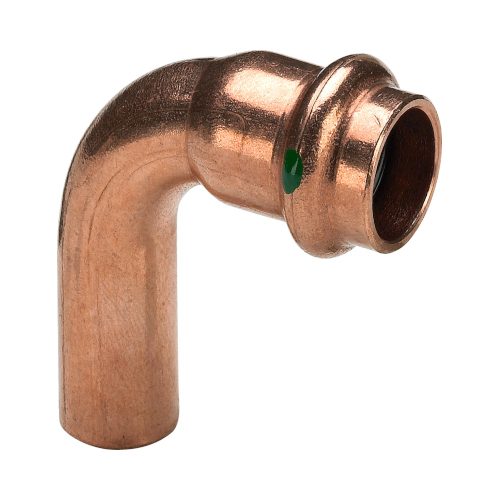
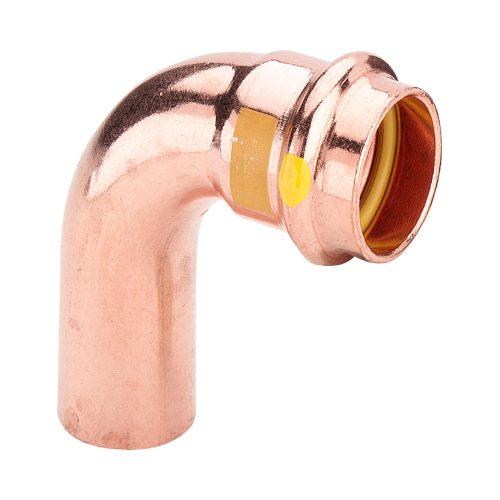
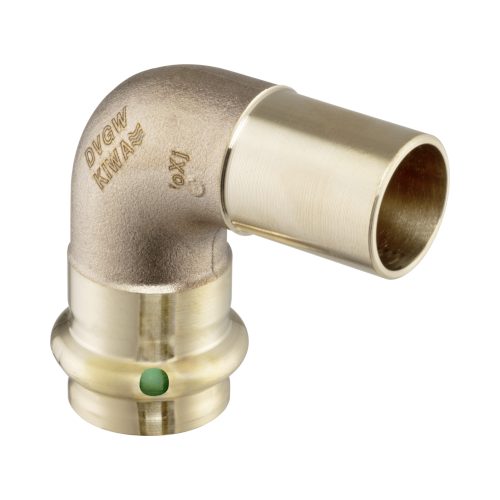
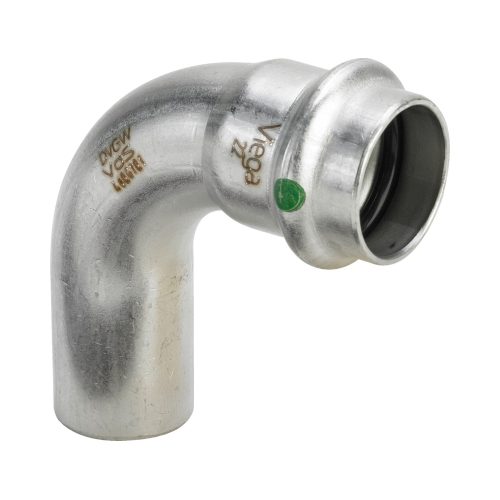
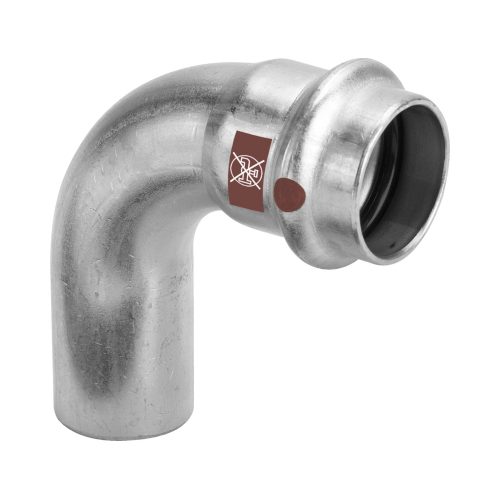
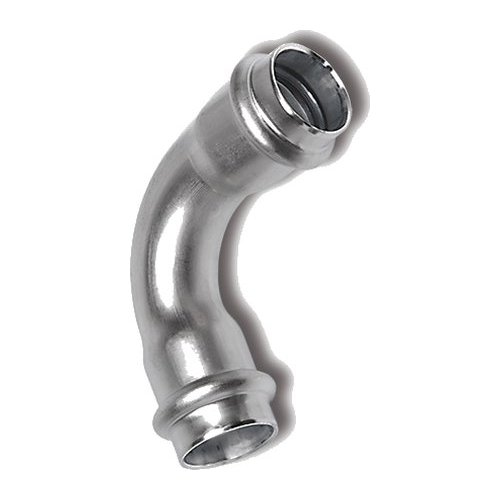
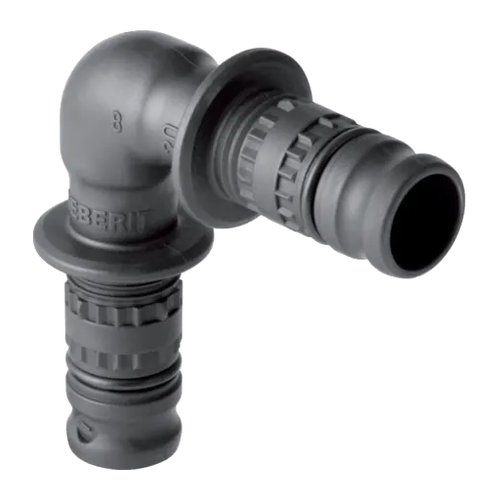
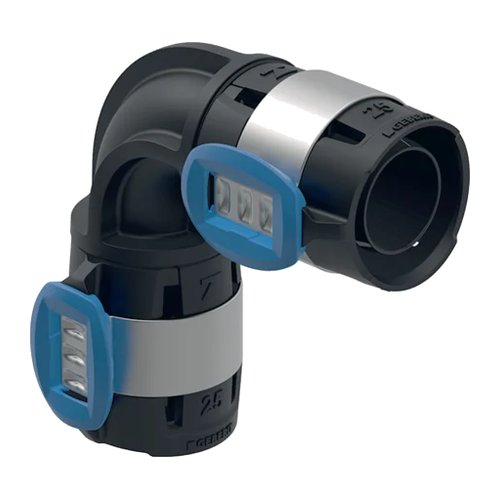
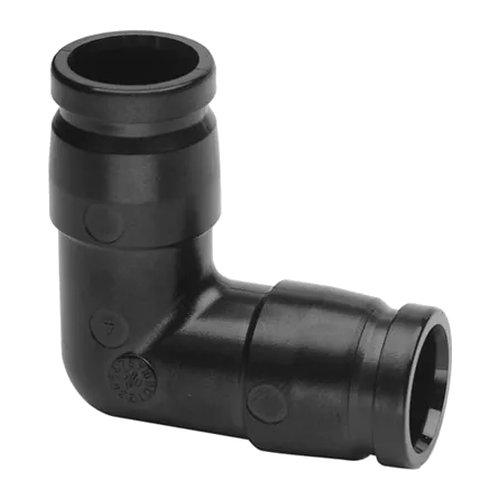
In pictures: 90° elbows of the systems we carry
Where press systems come from – and why they belong in industry and plant construction
Press systems grew up in building services. The first press connectors for copper and stainless-steel pipe came on the market around 1970 – Geberit dates its entry into press technology to “more than 55 years ago” – but long remained a niche method beside soldering: according to Viega's planning manual, soft and hard soldering was the dominant method of drinking-water installation from 1970 to 2000; only afterwards did the press joint establish itself as the market-leading joining technology. What carried the change was not the joint itself but its surroundings: cold processing without flame, seconds instead of minutes, no fire watch, a defined quality without the manual skill of soldering – and safety profiles that make the forgotten press visible.
Exactly these advantages apply in plant construction and industry at least as much as in housing: there, work is done in existing plant, under running production, in areas with permit and fire watch, with welders who are scarce, and with downtime costs that make every assembly hour expensive. That is why variants for heating and cooling, compressed air, technical gases, fire-fighting water, solar and district heating grew out of the drinking-water systems, and that is why press technology with Megapress and Heavy Steel Press now reaches the thick-walled steel pipe of pipeline construction – up to 4 inch, with flange adapters up to PN 40. With us, press technology has a longer history than the range suggests: as early as the 1970s and 1980s the first press-fitting system was in our stock through our business connection with the Mannesmann tube works – Mapress, born of the pressing of metal pipes patented in 1964, which Mannesmann brought to market maturity. The market was not yet ready: soldering and welding remained the standard, press technology only prevailed in the 1990s, and we let the system rest. In the early 2000s, when press joints became interesting for industry and plant construction as well, we rebuilt press technology – in 2002 the systems came back into the range, at first for installation, today looked after by building services together with pipes, flanges, fittings and valves. That their advantages apply equally in plant construction was the reason to expand them, as a long-standing contract dealer of Viega, Sanha, Geberit and GF, for industrial customers, right up to Megapress for thick-walled steel pipe. Whoever equips a plant today gets butt-welding fitting, flange, grooved coupling and press connector from one warehouse – and the decision which joint carries where from one source.
Pressing in pipeline construction: Megapress for thick-walled steel pipe
The system-pipe systems end at 108 mm and at pipes the manufacturer delivers calibrated. Pipeline construction works with other material: thick-walled threaded and boiler tube to EN 10255 and EN 10220, black or galvanised, seamless or welded – the pipe that lies in our stock as bar stock and has so far been welded, threaded or grooved. Viega Megapress presses exactly this pipe, ⅜ to 2 inch and as Megapress S XL up to 4 inch (DN 100), with flange adapters up to PN 40; Sanha offers the counterpart up to 2 inch with Heavy Steel Press. Whether that replaces the weld seam depends on size, pressure, temperature, medium and above all on whether work has to be done in existing plant without fire – the page Megapress or welding walks through the decision criterion by criterion. In our pipe dimension tables every size shows which press and coupling systems are approved for it.
Mixed installation, corrosion, tools – the cross-cutting topics
- Mixed installation and corrosion: joints between different materials have to master thermal expansion, contact corrosion and sealing system. Observe the flow rule, insulating couplings at the transition from galvanised steel to stainless steel, no direct combination of components not approved for each other, use the system manufacturer's transition pieces. With copper connectors on Temponox pipe, a corrosion-protection tape at the joint.
- Press profiles and tools: system press tools, press jaws, press rings and articulated tension jaws for tight installation positions; Press Booster for the XL sizes; service intervals and safety shut-off; which jaw belongs to which system – and why visually identical profiles are never mixed.
- Sealing elements and media: EPDM, HNBR, FKM, CIIR and nitrile in detail, colour codes per manufacturer, media lists and what “suitable with restrictions” means.
- Leak testing and SC-Contur: wet and dry test, test pressures, ZVSHK leaflet, record – and why the safety profile only helps if a test is carried out.
- Zeta values: pressure-loss coefficients per system, fitting and size to DVGW W 575 for pipe network calculation.
The seven most frequent errors in practice
- Mixing components of different systems or manufacturers that are not approved for each other.
- Combining visually similar press profiles.
- Not marking and checking the insertion depth – the pipe slips out before pressing.
- Sealing element does not suit the medium: EPDM with oil, standard EPDM instead of FKM at high temperatures.
- Using a heating system (Temponox, Prestabo, SANHA-Therm, Megapress) for drinking water.
- Ordering only by nominal size or short designation instead of stating system, profile, sealing element and approval.
- Forgetting a press and filling the plant without a leak test – the safety profile reveals it, but only if a test is carried out.
From our practice: choosing systems – four lessons from plant construction
The data sheets say what a system may do. What has proved itself in projects is not written there. Four lessons from our consulting in industrial and plant construction – marked as experience values, not as manufacturer statements.
1. Few systems instead of many – and if several, then with one press profile
A plant construction project almost always runs better with few systems than with many. During construction the risk of confusion between visually similar connectors and profiles drops, there are fewer tool changes and less need for briefing. It pays off even more afterwards: maintenance and spare-parts stocking become more expensive with every additional system, because fittings, sealing elements and press jaws have to be kept per system. Our approach: first determine the line with the highest requirements – medium, pressure, temperature, approval – and fix the system for it. Then check how far this one system can be extended to the remaining lines. Only where it becomes uneconomic (stainless steel for a closed heating circuit where carbon steel is enough) does a second system come in – and then preferably one that is pressed with the same press profile. That way no jaws have to be changed on site, and one jaw set is enough later for maintenance and extension. The system finder names the profile for every hit; systems of one manufacturer with the same profile (at Viega the SC-Contur of Profipress, Sanpress, Sanpress Inox and Temponox, at Sanha the SA, V and M profile) can thus be processed with one tool. What stays the same: the components themselves are not mixed – same profile means same tool, not same system.
2. Where it has to be quick and uncomplicated: the push-fit system
In simple applications where speed and robustness of processing count – prefabricated housing, refurbishment of large residential complexes, series bathrooms, floor distributions – the push-fit system GF iFIT is a good alternative to pressing: installed without tools, low demands on the tradesman, no press tool and no jaw sets. One crew can carry out several trades with it without specialist knowledge or expensive machines having to be available at every point. The limits belong to it: d16 to d32, drinking water and heating up to 70 °C and 10 bar – for risers of larger size, industrial or gas applications it is no replacement. That the push-fit joint can be detached non-destructively helps with alterations and corrections during ongoing fit-out.
3. Repair and refurbishment: transitions are always possible
In existing buildings one rarely meets a single system. That is no obstacle: between the systems a transition can almost always be made – with the manufacturers' transition pieces (press end to thread, to flange, to groove), if in doubt via the intermediate installation of a threaded joint: transition piece with male thread on one side, with female thread on the other, sealing on the thread to EN 10226-1 in between. Three things belong to it: observe the material pairing (flow rule, insulating coupling at the transition from galvanised steel to stainless steel – see mixed installation), check the approval per medium (for gas only approved transition pieces) and document the transition in the as-built plan so that the next repair does not start from scratch again.
4. Why we carry the systems of the market leaders – and no private labels
Press systems are not standardised. The DVGW worksheet W 534 regulates requirements and tests, but no dimensions: overall lengths, z-dimensions, profiles and sealing elements are defined by each manufacturer itself, and the approval applies to the system of pipe, connector and tool. A press connector is therefore not a standard part that anyone can supply in twenty years, but a manufacturer's part that will then only exist if the manufacturer still carries the system that way. In housing that is rarely a problem; in industrial and plant construction it is one: plants run for decades, spare parts have to fit into the existing line with the same overall lengths and z-dimensions, and with apparatus that is subject to an approval or test and is built in series over years, the originally tested component still has to be available – otherwise a spare part turns into a component change that triggers a new assessment. That is why we carry the systems of the large manufacturers that have been on the market for decades and continue their systems with the same dimensions, and no private labels or systems of smaller suppliers that are made somewhere and for which nobody can say whether fitting, sealing element and jaw will still exist in ten years. We follow the same principle with the malleable-iron fittings from GF: there the dimensions are standardised in EN 10242, but the overall lengths unchanged for decades and the reliable supply make the difference in existing plant. What we observe with customers who deal with this: they specify the systems of the market leaders for non-standardised joints – also because their maintenance crew knows these systems and the jaw sets for them are in house. In public tenders the make specification is tied to the addition “or equivalent”; connection to an existing plant and spare-part compatibility are recognised reasons to specify a make. Two things belong to honesty: even a market leader discontinues systems – which is why system, model number and sealing element belong in the plant documentation. And replacing a connector with a part of the same original condition is not a change subject to testing, a different part with different dimensions or materials may be one – the assessment lies with the operator within the scope of its risk assessment.
What the z-dimension is – and why it matters for maintenance and repair. The z-dimension of a fitting is the take-off dimension from the centre of the fitting to the end of the pipe inside the socket – the length the fitter deducts from the centre-line length when cutting the pipe. It is listed in the manufacturer's documents for every fitting and size. It is standardised only where a product standard fixes the dimensions – for malleable iron fittings the dimension z in EN 10242, for flanged valves the face-to-face length in EN 558; for press systems the manufacturer sets it, because DVGW W 534 regulates no dimensions. For a new installation it is a figure in the catalogue; for maintenance it is the decisive value: a replacement fitting with a different z-dimension does not fit the existing line, and the pipe section has to be remade. It is an argument we keep putting to customers in favour of branded systems – for press systems just as for GF malleable iron fittings: the z-dimensions have remained unchanged for decades, and the availability of the parts has proved itself over decades. Whoever has to maintain or repair a plant buys that reliability together with the system. Not to be confused with the zeta value, the loss coefficient used in pipe network calculation.
A second reason is range breadth. The large manufacturers carry hundreds of components per system – Viega names more than 800 different press connectors and system components for Profipress, 400 for Prestabo – with all sizes, intermediate sizes such as 64 or 67 mm, reductions over several steps, transitions to thread, flange and other systems, wall plates, unions and special components. Smaller suppliers often cover only the common sizes and basic shapes. What is one reducer with our systems becomes two or three reducers in a row there – that not only looks worse and costs more, it is also two or three joints instead of one: each with its own insertion depth, its own press, its own pressure loss and its own assembly time. In plant construction, where lines are densely packed and every connector needs space, component variety is therefore not a comfort but part of the economics. Industry and plant construction in particular expect both: long-term availability over the service life of the plant and a range that maps the pipe routing with as few joints as possible.
Show full table · more than 20 rows
Seven rules from consulting that have proved themselves
- Think from the medium. First define the medium with its operating conditions – temperature, pressure, additives such as oil or antifreeze – from that follow sealing element and system. A typical error is a standard EPDM in a line for whose medium it was never approved, such as oil, steam or solar.
- Measure the existing pipe before quoting. With Megapress in existing plant, check outside diameter, wall thickness and surface (rust, paint, scale) before quoting – the manufacturer's pipe overview decides whether pressing is allowed, not the label “threaded pipe”.
- Plan additional fittings. Beyond the take-off, take additional elbows, tees and couplings per size to the site; a missing part costs more time than all the pressing.
- Make sure the right tool is available on site. Before starting assembly, check that the right tool is at hand for the chosen system and every size – press jaws with the matching profile, for large sizes the corresponding tool. If something is missing, feel free to ask us for it along with the material.
- Document the installed systems. Record system, sealing element and the installed transition pieces (type, material, thread, location) in the plant documentation; at the next extension or repair that is the most valuable information.
- Downtime costs beat material price. In running operation the plant downtime – fire watch, gas-free certification, cooling down – usually decides the costs, not the material price; that is why the cost comparison calculator has a downtime mode.
- Keep drinking water and other media apart without risk of confusion. Systems for heating and industry (Temponox, SANHA-Therm, Megapress, Heavy Steel Press) sometimes look confusingly similar to drinking-water connectors. So watch the manufacturer's marking, store the material separately on site and label the lines. The same profile is no disadvantage here: it saves tooling, the distinction is made by the component.
Experience values Otto Zickwolff GmbH (consulting industrial and plant construction, as of 09/2026). They replace neither the design nor the system manufacturer's approval for medium, pressure and temperature.
Joining or repairing without welding? Compression fittings, repair clamps and tapping clamps join, seal and branch – without welding and without press tools. The tool shows which solution fits the pipe, outside diameter and medium. Which solution fits?
Does your press tool fit? Which press machine may drive the jaws and collars of a system is set out in the system manufacturers’ lists – the tool puts the lists of Geberit, Uponor and Viega side by side. Which press tool fits?
Pipe from one system, fitting from another? Which third-party pipes a manufacturer releases for its transition fittings, how to change from metal to plastic and what mixed installation means in fire protection – the system transition page sets out the manufacturer data. System transition: pipe and fitting from different systems
Frequently asked questions about press systems
Which press system suits which medium?
The system finder at the top leads via medium, temperature and pipe material to the suitable system; the system pages below give dimensions, seals and press profiles.
What is meant by a press joint?
Pipe and fitting are connected by controlled mechanical deformation: a press connector with an inserted sealing element is permanently pressed onto the pipe with a press tool – cold, without open flame, in seconds. Compared with welding, soldering and thread, fire watch, welding specialist and weld testing are dropped; the joint is immediately loadable but permanent.
Are the press profiles of different systems compatible?
No. Connector, sealing element, pipe and press tool form a jointly tested unit. Even if two profiles look similar, they must not be mixed – the joint would be outside any approval. Which jaw belongs to which system is stated in the manufacturer's compatibility list.
Which sealing element suits which medium?
EPDM (black) for drinking water, heating and cooling water, oil-free compressed air and technical gases; HNBR (yellow) for natural gas, LPG, hydrogen, heating oil and diesel; FKM for high temperatures, district heating, solar, oily compressed air; CIIR at Geberit Mepla for drinking water and heating. The manufacturer's media list is binding – the system finder shows it per medium.
Why is the insertion depth so important?
The connector holds and seals only if the pipe is inserted up to the stop. A pipe inserted too short can be pressed and still slip out under load. That is why the insertion depth is marked before pressing or checked at the sight window – with Raxofix also checkable after pressing.
What does “unpressed means leaking” mean?
A safety feature of the manufacturers (Viega SC-Contur, Sanha UVUD, Geberit leak paths): a joint that has accidentally not been pressed is necessarily leaking at the leak test and shows up before the plant goes into operation. The prerequisite is a leak test in the pressure range named by the manufacturer.
Can I combine systems of different manufacturers in one plant?
Yes, but only via transitions intended for it – threaded or flange adapters of the respective system – never by mixing connectors and pipes. The rules of mixed installation apply: flow rule, contact corrosion (galvanised steel against stainless steel with insulating coupling), thermal expansion.
Are there press systems for thick-walled steel pipe?
Yes: Viega Megapress presses threaded and boiler tube to EN 10255 and EN 10220 from ⅜ to 2 inch, as Megapress S XL up to 4 inch; Sanha Heavy Steel Press covers ½ to 2 inch. Both are not intended for drinking water, gas only in the HNBR variant. For larger sizes, grooved coupling, flange and weld seam remain.
Viega press systems from stock
As an authorised Viega contract dealer we carry the following systems in stock – straight to the matching shop category (shop in German):
Shop
Viega Profipress
Press fittings in copper for drinking water and heating.
Shop
Viega Profipress G (copper)
Gas version with yellow-marked HNBR sealing element.
Shop
Viega Profipress G (gunmetal)
Gunmetal version for gas installation, e.g. gas meter connections.
Shop
Viega Sanpress
Gunmetal connectors for stainless-steel pipe 1.4521 – drinking water.
Shop
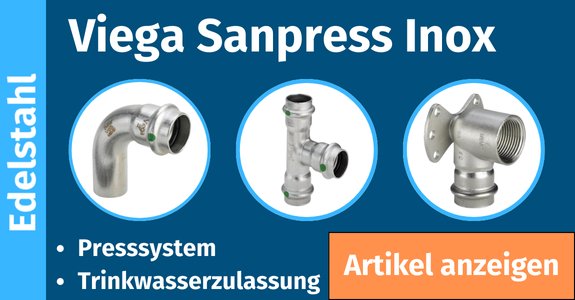
Viega Sanpress Inox
All stainless steel 1.4401 for the highest drinking-water hygiene.
Shop
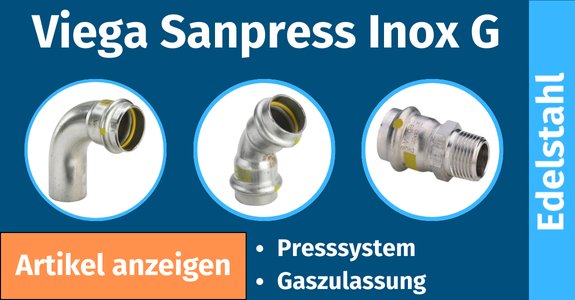
Viega Sanpress Inox G
Stainless-steel system for gas installation to DVGW-TRGI 2018.
Shop
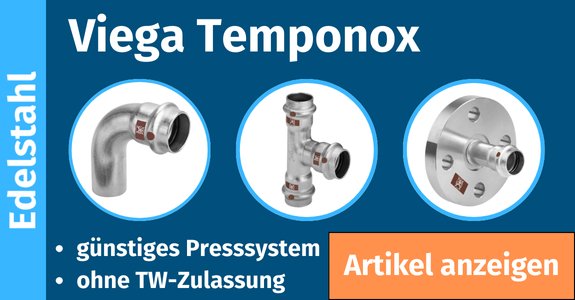
Viega Temponox
Stainless steel for heating/cooling – not for drinking water.
Product images: Viega
Sanha, Geberit, GF, Victaulic and Megapress – from stock or to order
The standard names dimensions. What is listed here, we carry – from stock or to order; how quickly a size is available we clarify on request. Tell us system, size and medium – we come back with availability.
Send an inquiryYour inquiry to Zickwolff
Send us what you have – designation, standard, quantity, date. We will clarify the rest with you.
One item or a question
Send inquiry
Not in stock? We procure it – single items too.
Designation, standard and quantity are enough.
Several items
Send bill of materials
200 items? One parts list is enough – we deliver complete.
Attach it as a file.
Helpful if already known: project and country, date needed, certificates, packaging and language of the packing lists. If anything is missing, we will ask.
It is urgent
Request express
When do you need it? Express delivery, to the site if required.
Tell us by when you need the material – we will tell you what is possible.
Technical basis: system documents, instructions for use, media lists and planning manuals of Viega, Sanha, Geberit, GF and Victaulic (contract-dealer material, use released), DVGW worksheets W 534, GW 541 and W 575, DVGW-TRGI; origin statements after Viega planning manual industrial technology (08/2026) and Geberit product line brochure supply systems (07/2025), ZVSHK leaflet on leak testing, German Drinking Water Ordinance (TrinkwV). Characteristic values, application limits and size ranges are manufacturer statements with the edition of the respective manufacturer document; availability names what we deliver from stock or procure. Information without guarantee – the manufacturer's current technical documents and approvals are binding; check the current system approval before installation. This page does not replace the manufacturer approval.