Press systems · Uponor RS 63–110
Uponor RS 63–110: multilayer pipe in large sizes – pre-pressed, pushed in, locked
Uponor RS is the modular fitting system for manifolds and demanding installation situations: multilayer composite pipe Uponor MLC in 63, 75, 90 and 110 mm, base bodies of tin-plated brass and press adapters with a permanently fitted stainless-steel press sleeve. The adapters are pressed at the workbench; on site they are only pushed in and secured with a locking element – no heavy press tool in the shaft or overhead. RS thus closes the gap between the multilayer systems of the storey and the metal press systems in the plant room and in plant construction. This page explains the modular kit, the joint, pipe and sizes, media with limits, tools, dimensions, zeta values and availability – and S-Press PLUS 14–75 as the smaller sizes of the same pipe family.
- Pipe
- Uponor MLC 63×6, 75×7.5, 90×8.5, 110×10 (PE-RT/Al/PE-RT, welded aluminium layer)
- Sizes
- 63–110 mm (connection to 16–50 via adapters)
- Fittings
- base bodies and adapters of tin-plated brass, stainless-steel press sleeve, plastic locking element
- Joint
- pre-press the press adapter · push into the base body · lock · leaks if unpressed
- Pressure / temperature
- drinking water 10 bar / 70 °C · heating 10 bar / 80 °C
- Availability
- available on request from Uponor – Zickwolff is an authorised distributor
What Uponor RS is intended for
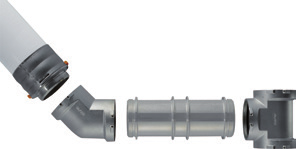
Uponor lists distribution and riser lines in drinking-water and heating/cooling systems, also in larger residential and commercial buildings – above all the flexible assembly of main manifolds in the plant room instead of project-specific welded steel manifolds. A tee manifold is made from tee base bodies and spacer adapters, a change of direction at any angle from two 45° elbows with the 5 mm spacer, a change of level from a spacer adapter and a 45° elbow. Everything remains adjustable until the tightness test, and hundreds of fitting variants can be made from a few components – which relieves planning and stock.
In our experience, multilayer pipe in these sizes is also interesting for plant construction with water as the medium: cooling and heating circuits, distribution lines in plant rooms, connections between generator and manifold – wherever the limits of 70 or 80 °C at 10 bar suffice and weight, freedom from corrosion and installation without hot work count. RS is not intended for gas (Uponor excludes gas installations), for solar or district-heating systems above the continuous operating values, or for compressed air as an operating medium (named only as a test medium). For those the metal systems are available – Viega Sanpress Inox, SANHA NiroSan or Viega Megapress.
How the joint works
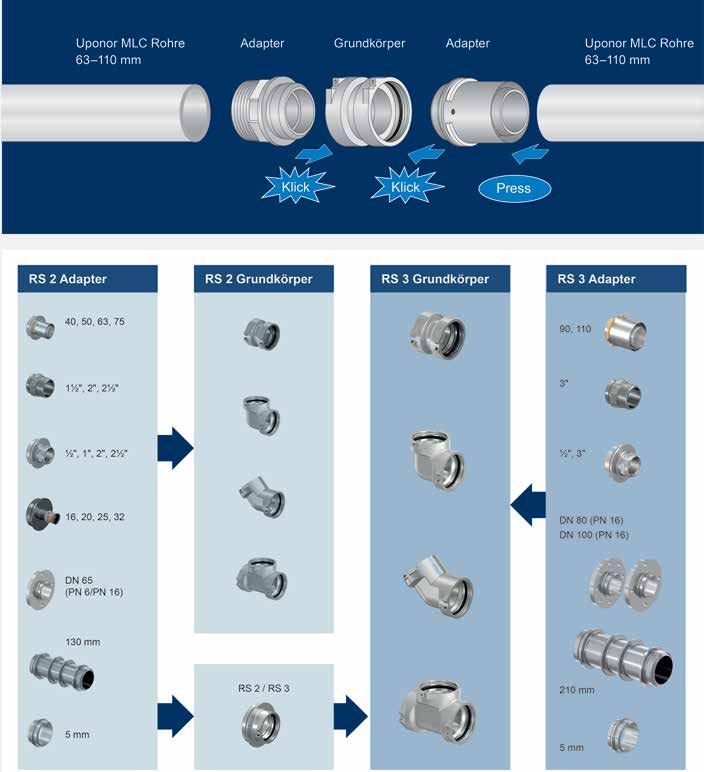
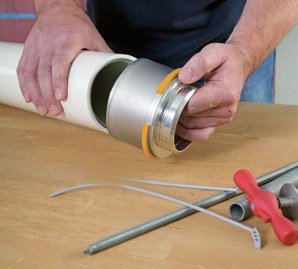
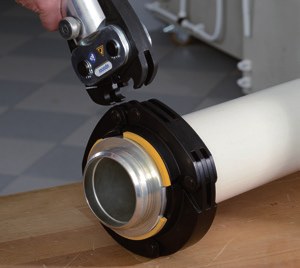
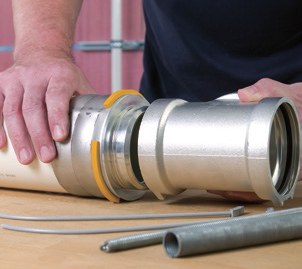
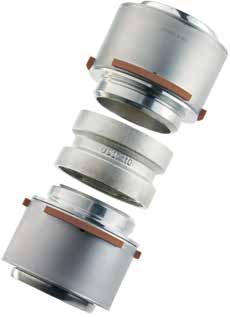
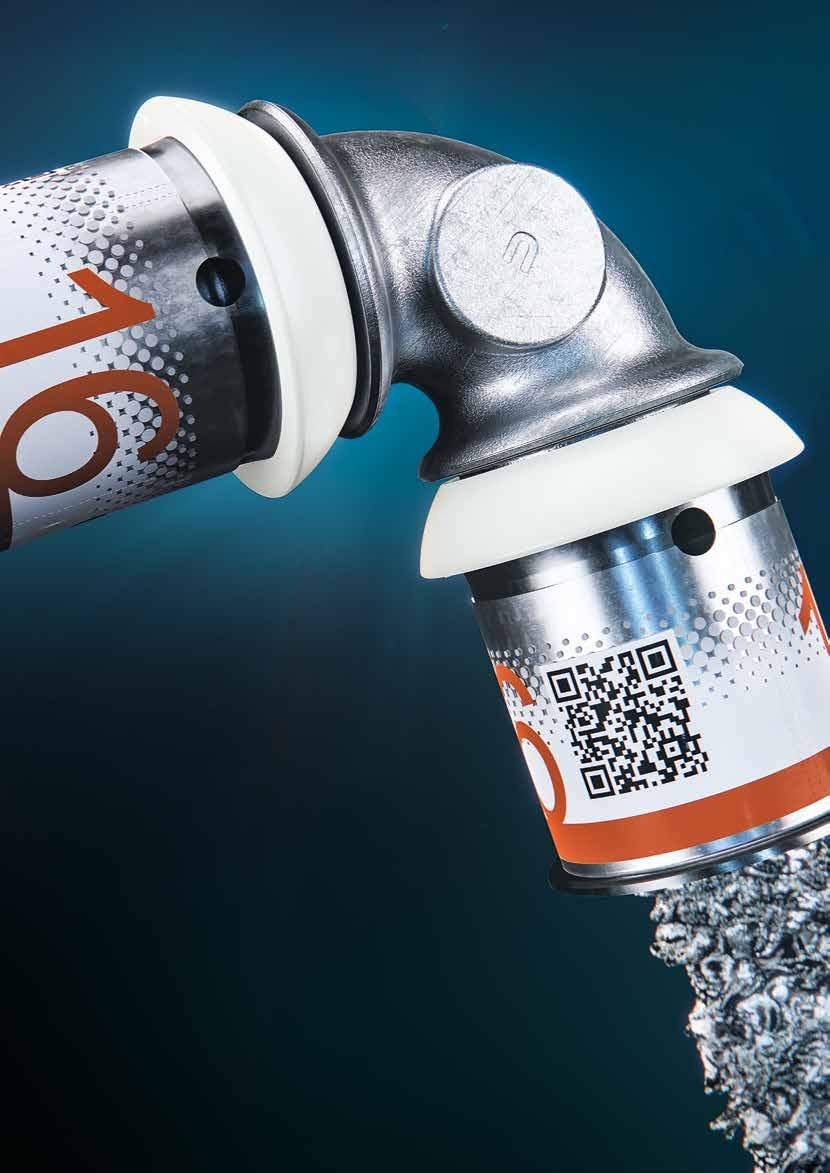
RS separates the pressing from the assembly at the installation point. The press adapter carries a permanently fitted stainless-steel press sleeve with a coloured stop ring (colour code per size) and is pressed with press collar and base press jaw – at the workbench, in the workshop or on the floor of the plant room, where space and force are no problem. Then the pre-pressed adapter is pushed into the base body (audible click) and secured with the plastic locking element, which is slid into the opening of the base body and snaps in. The base bodies themselves – coupling, elbows 90° and 45°, tee – need no tool.
The pressed indicator is the press impression on the stainless-steel sleeve (visual check). Unpressed RS joints leak in the tightness test – a forgotten pressing is noticed before the line goes into operation. The press adapters seal against the base body via O-rings; the Uponor documents do not name the seal material, and fittings with damaged O-rings must not be installed.
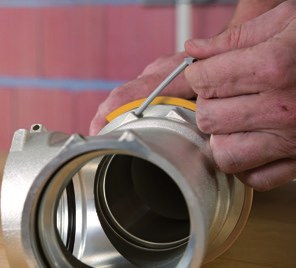
The modular kit: RS 2 and RS 3
The base bodies come in two size classes. RS 2 takes the press adapters 40, 50, 63 and 75 (MLC), the S-Press PLUS adapters 16, 20, 25 and 32 (Uni Pipe PLUS), threaded adapters R 2 and R 2½ (male), Rp ½ to Rp 2½ (female) and the flange adapter DN 65 in PN 6 or PN 16. RS 3 takes the press adapters 90 and 110, threaded adapters R 3 and Rp ½ or Rp 3 and the flange adapters DN 80 and DN 100 (PN 16, flanges to EN 1092-3). The reducing coupling RS3-RS2 joins both classes; spacer adapters exist in both. Threads comply with EN 10226-1.
| Component | RS 2 | RS 3 | Note |
|---|---|---|---|
| Base bodies | coupling, elbow 90°, elbow 45°, tee | coupling, elbow 90°, elbow 45°, tee | including locking elements, tin-plated brass |
| Press adapters MLC | 40, 50, 63, 75 | 90, 110 | stainless-steel press sleeve permanently fitted, colour code per size |
| Adapters S-Press PLUS / S-Press | 16, 20, 25, 32 | – | connection of Uni Pipe PLUS to the manifold |
| Threaded adapters nipple (R) | R 2, R 2½ | R 3 | male thread EN 10226-1 |
| Threaded adapters socket (Rp) | Rp ½, Rp 1, Rp 2, Rp 2½ | Rp ½, Rp 3 | female thread, Rp ½ for drain and vent |
| Flange adapters | DN 65 PN 6, DN 65 PN 16 | DN 80 PN 16, DN 100 PN 16 | flanges to EN 1092-3 |
| Spacer adapters | 5 mm, 130 mm | 5 mm, 210 mm | manifolds, changes of level, fixed point (circumferential ribs) |
| Reducing coupling | RS3-RS2 | transition between the size classes | |
| Locking element | black | grey | plastic, spare part |
Dimensions of the adapters and base bodies
The dimensions come from the article tables of the system manual (07/2026), all in millimetres: l = overall length, l1 = insertion length into the base body (uniformly 20 mm), l2 = insertion depth of the pipe or threaded or flange side, z1 = Z dimension of the adapter. For the overall length of a combination add base body and adapter – the base bodies have l 58 (coupling) or l1 = l2 (= l3) 51 for RS 2 and 68 for RS 3 (elbow and tee). Pipe lengths follow the Z-dimension method: pipe length = overall length minus the Z dimensions of the two fittings. Z dimensions of assembled combinations and weights are not given in the documents – on request we clarify them with Uponor.
Show full table · more than 20 rows
| Adapter | Size class | l1 | l2 | l | z1 |
|---|---|---|---|---|---|
| Press adapter 40, 50 | RS 2 | 20 | 37.9 | 64.8 | 6.9 |
| Press adapter 63, 75 | RS 2 | 20 | 60.7 | 87.8 | 7.1 |
| Press adapter 90, 110 | RS 3 | 20 | 62 | 92.6 | 10.6 |
| Adapter S-Press 16 | RS 2 | 20 | 21 | 60.8 | 19.8 |
| Adapter S-Press PLUS 20 | RS 2 | 20.1 | 21.3 | 60.9 | 19.5 |
| Adapter S-Press PLUS 25, 32 | RS 2 | 20.1 | 28.3 | 74.9 | 26.5 |
| Threaded adapter R 2 | RS 2 | 20 | 23.4 | 66 | 22.6 |
| Threaded adapter R 2½ | RS 2 | 20 | 27.1 | 62.8 | 15.7 |
| Threaded adapter R 3 | RS 3 | 20 | 29.8 | 72.6 | 22.8 |
| Threaded adapter Rp ½ | RS 2 / RS 3 | 20 | 15 | 42 / 43 | 7 / 8 |
| Threaded adapter Rp 1 | RS 2 | 20 | 19.1 | 44.9 | 5.8 |
| Threaded adapter Rp 2 | RS 2 | 20 | 25.7 | 54 | 8.3 |
| Threaded adapter Rp 2½ | RS 2 | 20 | 30.2 | 62.5 | 12.3 |
| Threaded adapter Rp 3 | RS 3 | 20 | 33.3 | 65.3 | 12 |
| Flange adapter DN 65 PN 6 | RS 2 | – | – | 38 | 18 |
| Flange adapter DN 65 PN 16 | RS 2 | – | – | 45 | 25 |
| Flange adapter DN 80 PN 16 | RS 3 | – | – | 45 | 25 |
| Flange adapter DN 100 PN 16 | RS 3 | – | – | 44 | 24 |
| Spacer adapter 5 mm | RS 2 / RS 3 | 20 | 20 | 45 | 5 |
| Spacer adapter 130 mm | RS 2 | 20 | 20 | 170 | 130 |
| Spacer adapter 210 mm | RS 3 | 20 | 20 | 250 | 210 |
| Reducing coupling RS3-RS2 | RS 3 → RS 2 | 20 | 19 | 47 | 8 |
Flange adapters: bolt circle k 130 (DN 65 PN 6), 145 (DN 65 PN 16), 160 (DN 80) and 180 mm (DN 100), outside diameter 160, 185, 200 and 220 mm – the counter-flanges with bolt pattern to EN 1092 are in our flanges.
Pipe, sizes and availability
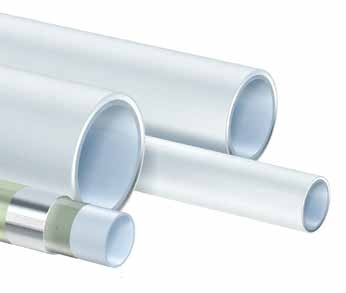
The pipe is Uponor MLC: an oxygen-diffusion-tight five-layer composite pipe of PE-RT, adhesive, aluminium, adhesive and PE-RT with a safety-welded aluminium layer, in straight lengths (63 in 3 and 5 m, 75 to 110 in 5 m), white, with hygiene end caps to EN 806 and fire class E to EN 13501-1. It is dimensionally stable but can no longer be bent by hand in these sizes – changes of direction are made with elbows and spacer adapters.
| Size da × s (mm) | Inside ø (mm) | Water content (l/m) | Weight empty (g/m) | Support spacing horizontal / vertical (m) | Minimum pipe length between two fittings (mm) |
|---|---|---|---|---|---|
| 63 × 6.0 | 51 | 2.040 | 1224 | 2.20 / 2.85 | 150 |
| 75 × 7.5 | 60 | 2.827 | 1788 | 2.40 / 3.10 | 150 |
| 90 × 8.5 | 73 | 4.185 | 2545 | 2.40 / 3.10 | 160 |
| 110 × 10.0 | 90 | 6.362 | 3597 | 2.40 / 3.10 | 160 |
Pipe roughness k = 0.0004 mm, thermal conductivity 0.40 W/mK, linear expansion 0.025 mm/mK – similar to metal pipe, not plastic pipe. The sizes of the RS system at Zickwolff:
| Size | Outside ø (mm) | DN | Availability |
|---|---|---|---|
| d 63 | 63 | 50 | available on request |
| d 75 | 75 | 65 | available on request |
| d 90 | 90 | 80 | available on request |
| d 110 | 110 | 100 | available on request |
The standard names dimensions. What is listed here, we carry – from stock or to order; how quickly, we clarify on request.
Which medium with which limits
Uponor names the same system values for pipe and all fittings: drinking water 0–70 °C at 10 bar continuous operation, short-term malfunction temperature 95 °C for at most 100 hours in total; heating 80 °C at 10 bar, malfunction 100 °C for 100 hours. Heating/cooling is released, antifreeze only with the agents released by Uponor (four products, list in the system manual) at 25 to 80 per cent by volume – other agents must not attack polyethylene, EPDM, PPSU and brass. Chemical disinfection is permitted to EN 806-4 and the DVGW codes of practice; repeated disinfections are to be rejected. Compressed air appears only as a test medium (tightness test 150 mbar, load test at most 1 bar above 63 mm); gas is excluded.
| Medium | Uponor RS |
|---|---|
| drinking water | suitable 70 °C / 10 bar short-term fault temperature 95 °C for max. 100 h in total |
| heating water (closed circuit) | suitable 80 °C / 10 bar short-term fault temperature 100 °C for max. 100 h in total |
| cooling water | suitable 80 °C / 10 bar heating/cooling applications, limits as for heating water |
| cooling water with antifreeze (glycol) | with restrictions (manufacturer approval) 80 °C / 10 bar antifreeze products released by Uponor only (list in the system manual), 25 to 80 % by volume |
| solar circuit | not suitable |
| district heating (sub-station side) | not suitable |
| natural gas (DVGW G 260) | not suitable |
Do not connect directly: systems that exceed the continuous operating values – solar and district-heating systems, instantaneous water heaters without electronic control. The transition belongs downstream of the heat exchanger or the temperature limiter. Multilayer pipe is not conductive and is not suitable for equipotential bonding.
Tools and space requirement
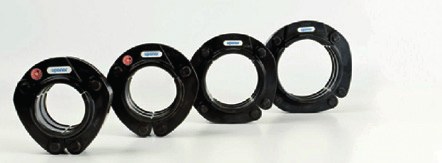
For 63 to 110 mm you need the Uponor base press jaw with the press collar of the respective size – collar and fitting carry the same colour code – on a press machine with at least 32 kN: Uponor UP 110 (battery), UP 75 or UP 75 EL (230 V). Of the third-party press machines in the Uponor approval list, only two Hilti tools are released for the press collars 63–110 (NPR 032 PE-A22 and NPR 32 XL-22); for other makes Uponor requires confirmation from the machine manufacturer. Cut to length with the pipe cutter 63–110 or the multi pipe cutter, then deburr – mandatory for 40 to 110 mm. Uponor recommends inspecting the press jaws every three years. Which jaw belongs to which system is under Press profiles and tools.
| Size | A (to the wall) | B (between pipes) | C (to the ceiling) |
|---|---|---|---|
| 63 × 6 | 80 | 125 | 75 |
| 75 × 7.5 | 82 | 130 | 82 |
| 90 × 8.5 | 95 | 140 | 95 |
| 110 × 10 | 105 | 165 | 105 |
Expansion, fixed points, pressure loss
The change in length is calculated with 0.025 mm per metre and kelvin – 25 m of line at 40 K expand by 25 mm. Pipes must not lie rigidly between two fixed points; the compensation sits between fixed point and change of direction, and Uponor calculates the bending leg length with the material constant 30. The spacer adapter with its circumferential ribs is suitable as a fixed point. The fixed-point clamps must take up the expansion forces – at 75 K: 3050 N (63), 4300 N (75), 6500 N (90), 8950 N (110). The zeta values of the RS fittings to DIN 1988-300 and DVGW W 575 (technical information 02/2024):
| Dimension (mm) | elbow / bend 90° | elbow / bend 45° | coupling / socket | T-piece, branch (flow separation) | T-piece, run (flow separation) | T-piece, counter-flow (flow separation) | T-piece, branch (flow merging) | T-piece, run (flow merging) | T-piece, counter-flow (flow merging) | reducer |
|---|---|---|---|---|---|---|---|---|---|---|
| 63 | 2.3 | 1.0 | 0.8 | 2.5 | 1.0 | 3.1 | 4.0 | 8.0 | 6.0 | 0.5 |
| 75 | 3.1 | 1.0 | 0.6 | 3.2 | 0.7 | 4.1 | 3.5 | 7.0 | 5.0 | 0.3 |
| 90 | 2.4 | 1.0 | 0.0 | 2.8 | 0.2 | 4.0 | 3.5 | 6.0 | 5.0 | 0.0 |
| 110 | 2.4 | 1.5 | 0.0 | 2.8 | 0.2 | 4.0 | 3.5 | 6.0 | 5.0 | – |
How zeta values enter the pressure loss and where the values of the other systems are is explained on the page zeta values of the press systems.
S-Press PLUS 14–75: the smaller sizes of the same pipe family
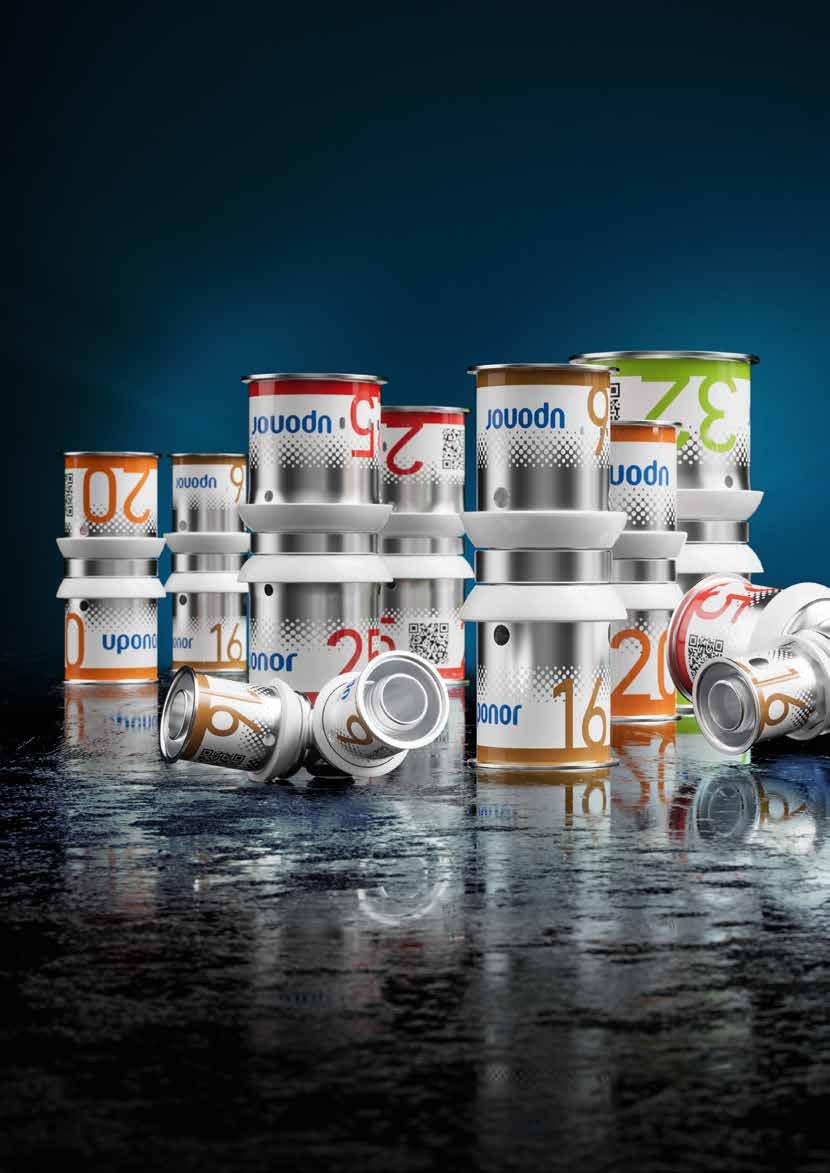
Below 63 mm – and overlapping up to 75 – Uponor works with classic press fittings: S-Press PLUS is the current generation for 16, 20, 25 and 32 mm (Uni Pipe PLUS, the multilayer pipe with seamlessly extruded aluminium layer), S-Press covers 14 mm and 40, 50, 63 and 75 mm (MLC). We supply both, as we do RS. The fittings are made of dezincification-resistant tin-plated brass per the UBA positive list or of PPSU; the stainless-steel press sleeve is permanently connected to the fitting, guides the press jaw and protects the O-rings. RS and S-Press PLUS interlock: via the S-Press PLUS adapters 16–32 and the press adapters 40 and 50 the storey lines connect directly to the RS manifold.
What distinguishes S-Press PLUS, according to Uponor: a sight window in the press sleeve shows the insertion depth, a colour-coded indicator foil with QR code comes off during pressing – together with the visible deformation of the sleeve a double pressed check; unpressed joints leak in the tightness test with water and with air; pressing is done without calibrating and deburring in three steps (cut, push, press), and the fitting remains adjustable until pressed. The dezincification resistance was tested by the German Federal Institute for Materials Research and Testing (BAM) in the exposure test to DIN 50905-4 (eight weeks at 60 °C with constant oxygen input), the tensile strength in the test to the CSTB standard NF EN 1979 with 1600 N without failure of the press joint. The service limits are the same as for RS (drinking water 70 °C, heating 80 °C, 10 bar each); approvals DVGW, ÖVGW and KIWA/KOMO.
Profile and tool: Uponor’s own press jaws UPP1 (14 to 50 mm) on UP 110 / UP 75 / UP 75 EL and Mini KSP0 (14 to 32 mm) on the mini machine, 63 and 75 again with base press jaw and press collar. The jaws carry the marking U and the same colour code as the fitting, recognisable from up to five metres away. No new jaws were needed for the PLUS generation. The Uponor documents do not name a release of third-party press jaws or an assignment to the profiles TH, U, H, B or F of other manufacturers – Uponor fitting, Uponor pipe and Uponor jaw are at the same time the condition of the ten-year liability declaration.
| Size | Outside ø (mm) | DN | Availability |
|---|---|---|---|
| d 14 | 14 | 10 | available on request |
| d 16 | 16 | 12 | available on request |
| d 20 | 20 | 15 | available on request |
| d 25 | 25 | 20 | available on request |
| d 32 | 32 | 25 | available on request |
| d 40 | 40 | 32 | available on request |
| d 50 | 50 | 40 | available on request |
| d 63 | 63 | 50 | available on request |
| d 75 | 75 | 65 | available on request |
Pipes: Uni Pipe PLUS 16×2, 20×2.25, 25×2.5 and 32×3 in coils and straight lengths, also pre-insulated and in conduit; MLC 40×4 and 50×4.5 in straight lengths. Minimum pipe length between two fittings 50 mm (16), 55 mm (20) and 70 mm (25, 32). Bending by hand up to 32 mm with a radius of 4 to 5 times da, with bending pliers 2 to 2.5 times da. Zeta values of the S-Press PLUS brass fittings:
| Dimension (mm) | elbow / bend 90° | coupling / socket | T-piece, branch (flow separation) | T-piece, run (flow separation) | T-piece, counter-flow (flow separation) | T-piece, branch (flow merging) | T-piece, run (flow merging) | T-piece, counter-flow (flow merging) |
|---|---|---|---|---|---|---|---|---|
| 16 | 7.1 | 1.9 | 7.4 | 2.3 | 7.6 | 13.2 | 26.4 | 18 |
| 20 | 5.1 | 1 | 5.2 | 1.2 | 5.4 | 8.1 | 21.2 | 12.1 |
| 25 | 4.2 | 0.8 | 4.7 | 1.1 | 5 | 7.7 | 17.1 | 10.6 |
| 32 | 3.3 | 0.5 | 3.4 | 0.7 | 4.1 | 6.7 | 14.7 | 7.9 |
RS or Mepla, FlowFit, Raxofix?
The other multilayer systems in our range end at 63 (Viega Raxofix) or 75 mm (Geberit Mepla, Geberit FlowFit) and are designed for the storey: press fitting on pipe, pressed at the installation point. RS is the only multilayer system in the range up to 110 mm and the only one with separate pressing – the difference counts in the manifold, in the narrow shaft and overhead. Below 63 mm the choice is a question of system family: whoever builds the storey with S-Press PLUS connects it directly to the manifold via the RS adapters; whoever installs Mepla or FlowFit stays in the Geberit family up to 75 and changes to metal above that. A comparison of all four is on the page multilayer and push-fit systems, the system selection by medium, pipe and size in the system finder.
Installation in brief
- Cut the pipe squarely and deburr it (mandatory for 40–110 mm), check the pipe end for damage.
- Push on the press adapter, check the insertion depth at the stop ring, press with press collar and base press jaw – at the workbench or on the floor.
- Push the pre-pressed adapters into the base body (click), slide in the locking element and let it snap in – the assembly remains rotatable until the tightness test.
- Make threaded connections before the pipe connection, only standardised threads to EN 10226-1, sealant without ammonia and chloride, no tool extension.
- Tightness test with water or dry (150 mbar, load test at most 1 bar above 63 mm); unpressed points leak, re-pressing is sufficient.
- Processing temperature −10 to +40 °C, press machines not below freezing. Fittings in concrete, screed or under plaster are permitted; protection only with permanent moisture penetration at pH above 12.5. In the ground and outdoors with corrosion-protection tape and UV protection.
- Installation times according to Uponor (two fitters): base body 1.5 min, press adapter 2.5 (RS 2) to 3 min (RS 3), threaded adapter 1 min.
Availability at Zickwolff
The standard names dimensions. What is listed here, we carry – from stock or to order; how quickly, we clarify on request. As an Uponor authorised distributor we procure Uponor RS with base bodies, adapters, locking elements, MLC pipe and tools – likewise S-Press PLUS, S-Press and the pipes Uni Pipe PLUS and MLC. Tell us size, medium, quantity and the mating parts (thread, flange), and we put the kit together.
Further in the topic
Tools of the pillar: system finder (which system fits medium, pipe and size) · Joining methods compared (pressing, push-fit, grooving, welding, thread, flange, brazing) · cost comparison calculator (installation time and downtime per method) · leak testing and the leak-if-unpressed feature · press systems overview.
Related multilayer and push-fit systems
| System | Pipe | Sizes | Availability |
|---|---|---|---|
| Viega Raxofix (multilayer composite pipe) | multilayer composite pipe | 16–63 mm | available to order |
| Geberit Mepla (multilayer composite pipe) | multilayer composite pipe | 16–75 mm | in stock 16–20; available to order 26–75 |
| Geberit FlowFit (multilayer composite pipe, lateral press technology) | multilayer composite pipe and polybutene pipe | 16–75 mm | in stock 16–25; available to order 32–75 |
| GF iFIT (push-fit system, polybutene and multilayer pipe) | multilayer composite pipe and polybutene pipe | 16–32 mm | in stock |
Matching from our range: flanges to EN 1092 as counterpart to the flange adapters, malleable iron fittings for threaded transitions, valves for isolation and control in the manifold.
Frequently asked questions on Uponor RS
Why is it called a press and push-fit system – is RS tight unpressed like a push-fit system?
No. Pressing is always done – the press adapter onto the pipe, with 32 kN. Only the pre-pressed adapter is pushed into the base body, secured by the locking element. Unpressed adapters leak in the tightness test. RS is not a tool-free push-fit system in the way GF iFIT is.
How hot may heating water be with Uponor RS?
Continuously 80 °C at 10 bar, briefly in a malfunction 100 °C for at most 100 hours in total. Drinking water 0–70 °C at 10 bar, malfunction 95 °C. Solar and district heating only downstream of a temperature limiter.
Which press machine do I need for 63 to 110?
A machine with at least 32 kN and the Uponor base press jaw with press collar per size: Uponor UP 110, UP 75 or UP 75 EL, of the third-party makes the two released Hilti tools. Because pressing is done at the workbench, the machine can stay stationary.
Can I build a manifold without welding?
Yes – from tee base bodies, spacer adapters 130 (RS 2) or 210 mm (RS 3), threaded or flange adapters for the valves and press adapters for the outlets. The spacer adapter also serves as a fixed point. The assembly remains rotatable until the tightness test and can be insulated afterwards.
How do I connect RS to steel or stainless-steel lines?
Via the threaded adapters (R 2, 2½, 3 male, Rp ½ to 3 female, EN 10226-1) or the flange adapters DN 65 to DN 100 to EN 1092-3. For drinking water observe the flow rule (mixed installation and corrosion) – tin-plated brass and stainless steel are compatible; the transition to galvanised steel belongs downstream in the direction of flow.
How do I recognise a forgotten pressing?
By the press impression on the stainless-steel sleeve – and by the tightness test: unpressed RS adapters leak. Re-pressing is sufficient.
Are the RS fittings also available in PPSU or lead-free?
According to the system manual 07/2026 the RS base bodies and adapters are available only in tin-plated brass. PPSU and dezincification-resistant brass are available for S-Press PLUS 16–32 and S-Press 40–75, lead-free brass for the S-Press PLUS transition coupling to copper and stainless steel.
Uponor RS, S-Press PLUS and multilayer pipe from one source
Tell us size, medium, quantity and the mating parts – we put together base bodies, adapters, pipe and tools and clarify availability and delivery time with Uponor.
Send an inquiryYour inquiry to Zickwolff
Send us what you have – designation, standard, quantity, date. We will clarify the rest with you.
One item or a question
Send inquiry
Not in stock? We procure it – single items too.
Designation, standard and quantity are enough.
Several items
Send bill of materials
200 items? One parts list is enough – we deliver complete.
Attach it as a file.
Helpful if already known: project and country, date needed, certificates, packaging and language of the packing lists. If anything is missing, we will ask.
It is urgent
Request express
When do you need it? Express delivery, to the site if required.
Tell us by when you need the material – we will tell you what is possible.
Technical basis: Uponor multilayer pipe system – system manual for installers (07/2026), technical information for drinking-water and heating installation (02/2024), S-Press PLUS brochure (09/2025) – material for authorised distributors, released for use; DIN 1988-300, DVGW W 575, EN 1092-3, EN 10226-1. The classification for plant construction is a Zickwolff experience value. Images: Uponor. The binding release remains with the manufacturer.