Standards guide · Malleable iron fittings
Malleable iron fittings: EN 10242, threads to EN 10226-1 and selection
Malleable iron fittings – in the trade often searched for as cast iron fittings – are threaded fittings made of heat-treated ("malleablised") cast iron: the classic detachable pipe joint for gas, water, heating and compressed air. This page puts the standards EN 10242 and DIN 2950 in context, explains material, threads and thread sealing – and lists the most common GF type numbers with their EN symbols.
- Standard
- EN 10242
- Replaces
- DIN 2950
- Threads
- R / Rp (EN 10226-1)
- Working pressure
- up to 25 bar (depending on medium/temperature)
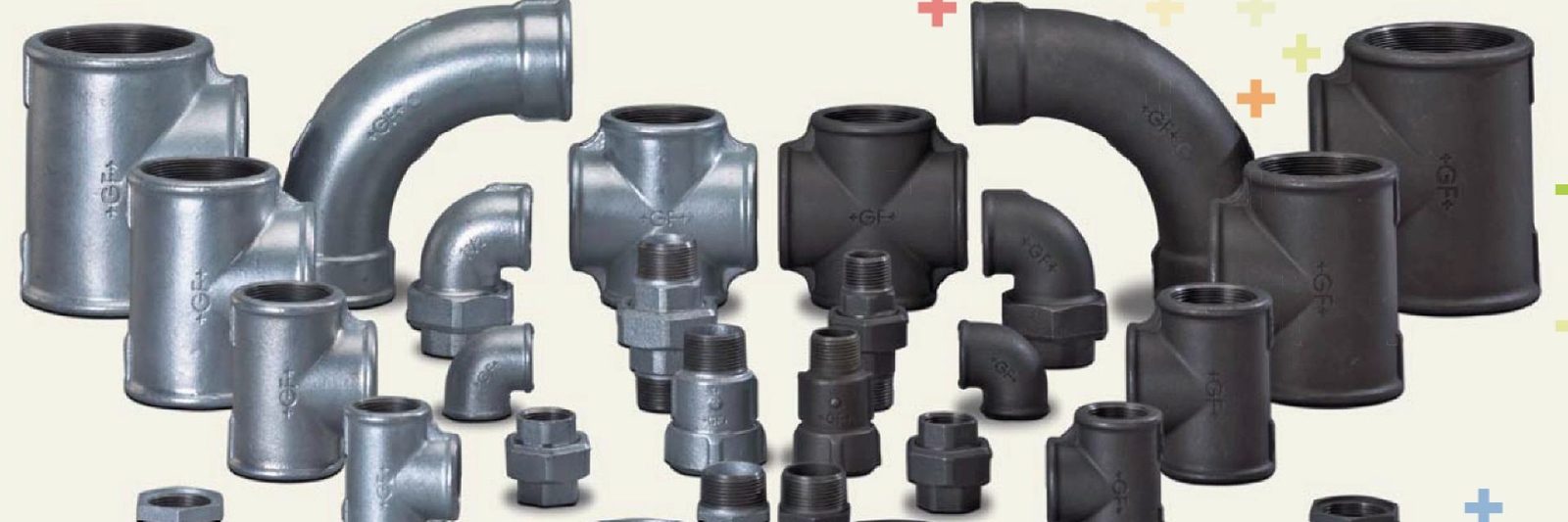
One of the largest GF malleable iron stocks in the German-speaking region: Zickwolff is an authorised Georg Fischer (GF) distributor and keeps one of the most comprehensive GF malleable iron stock ranges – including spare parts for maintenance of older installations. We deliver across Europe.
What are malleable iron fittings?
Malleable iron fittings are threaded fittings made of heat-treated ("malleablised") cast iron. The material combines the good castability of cast iron with steel-like toughness: complex fittings that nevertheless withstand high mechanical loads. Because components and threads are standardised throughout, an installation often remains extendable for decades – matching spare and extension parts are still available for many old installations, provided thread, dimension, material and approval match. This is exactly what makes malleable iron relevant for maintaining existing plants.
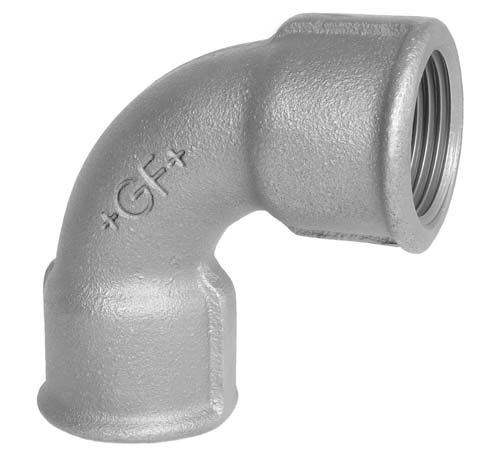
Where aggressive media or outdoor use call for higher corrosion resistance, stainless steel threaded fittings are the alternative – with the same R/Rp thread interface.
Standards: EN 10242 replaces DIN 2950
The product standard is EN 10242 (related: ISO 49). It has replaced the national standards – in Germany DIN 2950. If you work with old parts lists or existing plants using DIN 2950 designations, EN 10242 provides the successor system (special case United Kingdom: BS 143 & 1256 partly remains in use). The material standard is EN 1562.
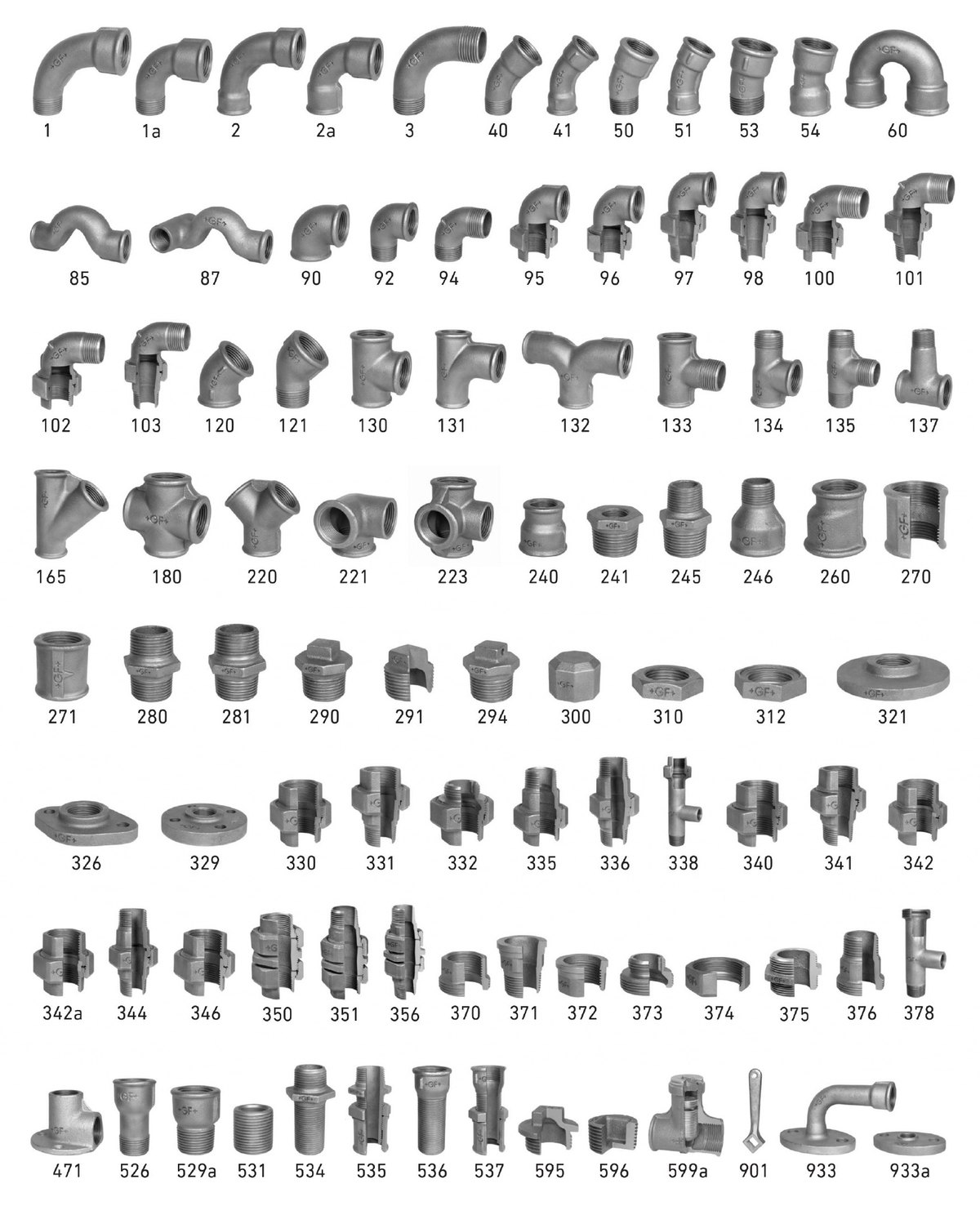
Reading a standard designation (example): Elbow EN 10242 – A1 – ½ – Zn – A = fitting type / product standard / fitting symbol / thread size / finish (Fe = black, Zn = galvanised) / thread version. In addition, manufacturers use type numbers (GF: type 1 bend, 90, 130, 340 … up to 933a) – in the trade the type numbers are the common ordering language, the EN symbols the tendering language.
Common GF type numbers (selection)
Show full table · more than 10 rows
| Type no. | Designation | ISO/EN symbol |
|---|---|---|
| 40 | 45° bend, long | G4/45° |
| 90 | 90° elbow, equal | A1 |
| 92 | 90° elbow, equal | A4 |
| 120 | 45° elbow | A1/45° |
| 130 | Tee, equal | B1 |
| 180 | Cross, equal | C1 |
| 240 | Socket, reducing | M2 |
| 241 | Reducing nipple | N4 |
| 270 | Socket | M2 |
| 280 | Hexagon nipple | N8 |
| 290 | Plug with rim | T9 |
| 300 | Cap | T1 |
| 310 | Backnut | P4 |
| 330 | Union, flat seat | U1 |
| 340 | Union, taper seat | U11 |
| 529a | Socket with female and male thread | M4 |
Material: whiteheart malleable cast iron
GF manufactures from whiteheart malleable cast iron EN-GJMW-400-5 to EN 1562 (tensile strength 400 N/mm², elongation 5 %). Other standard grades: EN-GJMB-350-10 (blackheart), EN-GJMW-350-4. The raw casting is hard and brittle; only the malleablising heat treatment produces the tough, machinable final structure. Important in practice: malleable cast iron is not a welding material like steel – higher temperatures change the microstructure; joints are made by thread, not by weld.
Threads: the most frequently confused topic
EN 10226-1 – sealing in the thread (standard for malleable iron): taper external thread R into parallel internal thread Rp (or taper internal thread Rc to Part 2) – the metallic sealing pressure is created in the thread itself.
EN ISO 228-1 – G thread (do not confuse): parallel, not sealing in the thread – sealed with a washer on a shoulder face.
- NPT (North American): its own taper angle and flank profile, not compatible with R/Rp despite similar appearance.
- GF features: reinforced, free-running, corrosion-inhibiting internal threads; high angular and dimensional accuracy (precise pipe runs, high metallic sealing pressure).
Most common mistake: mixing NPT, G and Rp/Rc – it looks right, but it never seals permanently.
Thread sealing
- Hemp + jointing paste: well proven for R/Rp metal threads; sealant to EN 751. Mistakes: too much hemp, contamination; unsuitable for oxygen.
- PTFE tape: with a standard right-hand thread, wind in the screwing-in direction so the tape does not unwind; number of layers and free thread turns per manufacturer's instructions. Mistakes: tape residues in the system, wrong winding direction.
- Anaerobic sealants: cure between metal faces in the absence of air; limits with inactive materials (e.g. stainless steel without activator) and large gaps.
- Always select by medium, temperature and approval (gas: approved sealants only).
Finishes: black or galvanised?
- Black (Fe): technical applications – gas, heating, compressed air, closed systems.
- Hot-dip galvanised (Zn): to EN 10242; GF uses high-purity zinc → suitable for drinking water (DVGW-certified). The galvanised version is intended for cold-water/drinking-water installation; electro-galvanising, by contrast, is only a thin protective coating – an important distinction.
Working limits and approvals
The standard range to EN 10242 covers liquids and gases up to 25 bar working pressure; typical media per GF catalogue: drinking water up to 60 °C, system waters up to 130 °C, natural/town/liquefied gas, compressed air (oiled and oil-free). For higher pressures there are specially pressure-tested fittings (burst-pressure tested, 100 bar test pressure, yellow marking). The test pressure is not a permissible working pressure – working pressure, medium and temperature follow from the data sheet of the specific version. Approvals: DVGW/ÖVGW/SVGW certificates, FM-approved range for fire-protection/sprinkler systems, CPR/RoHS/PED conformity, inspection documents to EN 10204 available.
Common mistakes in practice
- Mixing NPT, G and R/Rp threads.
- Ordering by nominal size only instead of type no. + standard + finish + thread version.
- Too much hemp or PTFE tape residues in the system; hemp with oxygen.
- Black fittings in drinking-water installations.
- Trying to weld malleable cast iron (changes the microstructure).
- Confusing electro-galvanised with hot-dip galvanised.
- Using standard fittings above 25 bar instead of the pressure-tested version (yellow marking).
Frequently asked questions
How does a pipe thread to EN 10226-1 seal?
A taper external thread R is screwed into a parallel internal thread Rp (or a taper internal thread Rc to Part 2) – the metallic sealing pressure is created in the thread itself. This is the standard for malleable iron fittings. Not to be confused with the G thread to EN ISO 228-1: parallel, not sealing in the thread – it seals with a washer on a shoulder face.
Do NPT fittings fit R threads?
No. NPT (North American) has its own taper angle and flank profile and is not compatible with R/Rp despite looking similar – it may screw in, but it will never seal permanently.
What matters when sealing with hemp?
Hemp with jointing paste is well proven on R/Rp metal threads; the sealant must comply with EN 751. Typical mistakes are using too much hemp and contamination; hemp is unsuitable for oxygen service.
What matters when using PTFE tape?
Winding direction and quantity are decisive: with a standard right-hand thread, wind the tape in the screwing-in direction so it does not unwind during assembly. The number of layers and the thread turns to leave free follow the manufacturer's instructions. Typical mistakes: tape residues in the system and the wrong winding direction. For gas, only approved sealants may be used.
When are anaerobic thread sealants suitable?
Anaerobic sealants cure between metal faces in the absence of air. Their limits are inactive materials (e.g. stainless steel without an activator) and large gaps. Selection always depends on medium, temperature and approval.
What is the difference between DIN 2950 and EN 10242?
EN 10242 is the product standard for malleable iron fittings and has replaced the national standards – in Germany DIN 2950. If you have old parts lists or existing installations with DIN 2950 designations, EN 10242 provides the successor system.
What does EN-GJMW-400-5 mean?
Whiteheart malleable cast iron to EN 1562 with 400 N/mm² tensile strength and 5 % elongation at fracture – the material GF uses for its malleable iron fittings.
Are galvanised malleable iron fittings suitable for drinking water?
GF fittings are hot-dip galvanised to EN 10242; GF uses high-purity zinc, which makes them suitable for drinking water (DVGW-certified). The galvanised version is intended for cold-water/drinking-water installation; electro-galvanising, by contrast, is only a thin protective coating.
Can malleable cast iron be welded?
Malleable cast iron is not a welding material like steel – higher temperatures change the microstructure. Connections are made by thread, not by weld.
What does the yellow marking on GF fittings mean?
The yellow marking identifies specially pressure-tested fittings for pressures above the 25 bar of the standard range – burst-pressure tested, 100 bar test pressure. The test pressure is not a permissible working pressure; the data sheet of the specific version governs.
GF malleable iron fittings – available from stock
One of the largest GF malleable iron stock ranges in the German-speaking region – threaded fittings to EN 10242, black or galvanised, delivered across Europe. Ask us for prices, availability and EN 10204 certificates.
Send us your inquiryTechnical basis: EN 10242 (formerly DIN 2950), EN 1562, EN 10226-1/-2, EN ISO 228-1, EN 751 and technical documentation from Georg Fischer (GF). All information without guarantee – the current standard texts and the manufacturer's technical data sheets always prevail.