Standards guide · Stainless steel threaded fittings
Stainless steel threaded fittings: threads, standards and why lengths vary
Stainless steel threaded fittings are the corrosion-resistant alternative to malleable iron and steel fittings – with one peculiarity that keeps raising questions in practice: the thread is clearly standardised, the fitting body only partly. This page places the standards (EN 10241, ISO 4144), explains the material short names V2A and V4A and shows why lengths and contours are allowed to differ between manufacturers – and when that matters.
- Thread
- R / Rp (EN 10226-1)
- Materials
- V4A, less often V2A (trade names)
- Standards for the body
- no product standard covering the whole market (ISO 4144 only for parts of it)
- Forms
- elbows, tees, sockets, nipples and others
In brief
On stainless steel threaded fittings the connecting interface is clearly standardised. This does not apply, however, to the outer form of the fitting body. Thread type and thread size follow defined thread standards. Lengths, outer contours, wall thicknesses and weights, on the other hand, may vary by product line, manufacturer and manufacturing method. For new installations this is often uncritical. For repairs, series assembly or confined spaces, a prior check of the actual installation dimensions is advisable.
What are stainless steel threaded fittings?
Stainless steel threaded fittings are pipe connectors of stainless steel with pipe threads – in demand wherever aggressive media, outdoor use, hygiene or drinking-water requirements call for a higher-grade material than malleable iron or unalloyed steel. The usual variety of forms ranges from elbows, tees and reducers over sockets (full and half), nipples, plugs and caps to unions and hose tails – each with internal and/or external thread depending on the form.
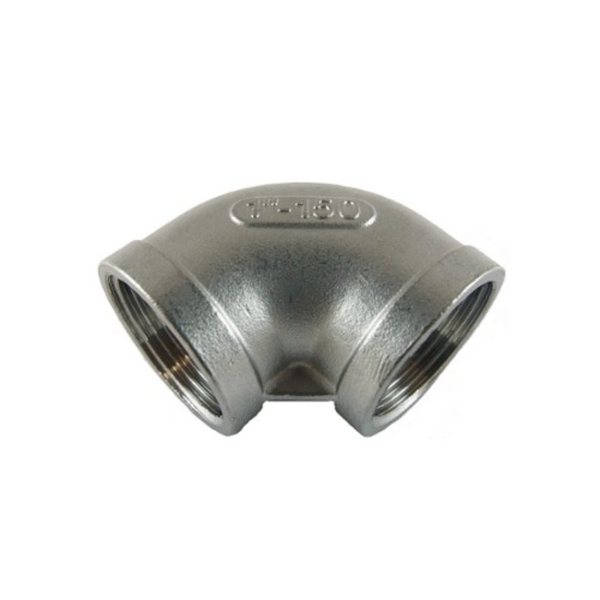
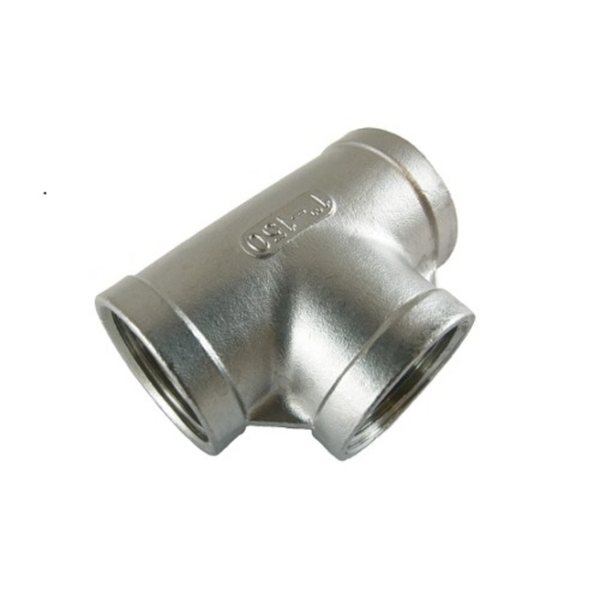
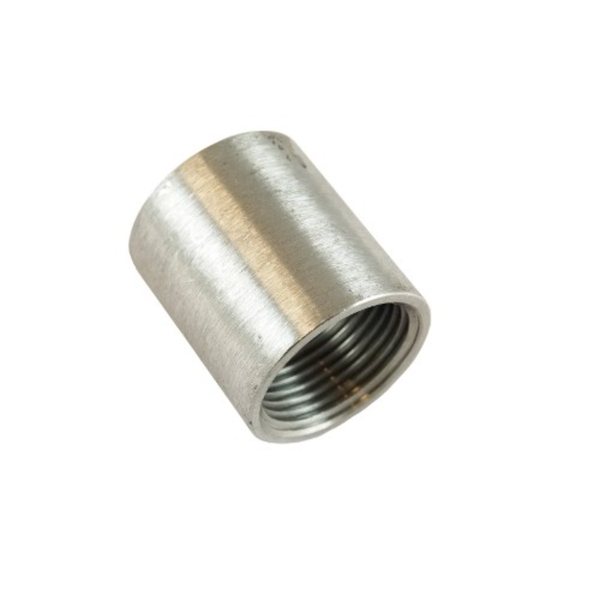
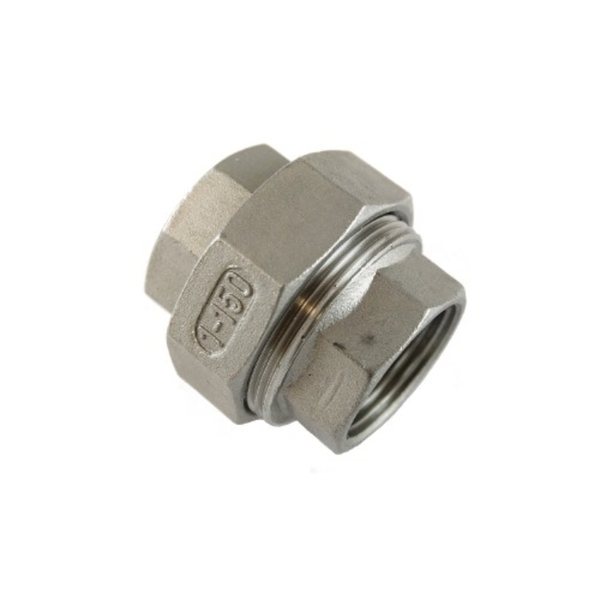
Stainless steel threaded fittings from the Zickwolff range. Pictures: Zickwolff
Zickwolff deliberately sources these customary, attractively priced stainless steel threaded fittings from different suppliers. Depending on supplier, availability, form and size, the delivered versions can differ in length, outer contour, wall thickness, weight, surface and manufacturing method – why this is normal in the heterogeneous stainless steel fittings market is explained in the following sections.
Placing the material short names: V2A and V4A are trade names, not standard designations. Behind them stand austenitic chromium-nickel and chromium-nickel-molybdenum steels; the most common material numbers are 1.4301/1.4307 (V2A family, AISI 304/304L) and 1.4401/1.4404/1.4571 (V4A family, with molybdenum for better resistance e.g. to chlorides, AISI 316/316L/316Ti). The complete assignment including the old DIN designations is on the materials page.
The thread: standardised and compatible across manufacturers
The thread itself follows – independently of the material – defined pipe thread standards. The standard in the European market is the system sealing on the thread to EN 10226-1: taper external thread R into parallel internal thread Rp. Alongside it exist the parallel G thread to ISO 228-1 (seals by a sealing ring on a shoulder face, typical for unions) and the American NPT to ASME B1.20.1.
Important: “standardised” does not automatically mean “compatible with each other” – what counts is that both sides have the same thread type and thread size. Then a fitting from manufacturer A connects without trouble to the counterpart from manufacturer B. A G thread, by contrast, is not automatically interchangeable with Rp (different tolerance zone – possible leak path), and NPT fits R/Rp or G in no size at all. The three thread systems with sealing-principle sketch, dimension table and all combination rules are compared on our German basics page on pipe threads.
The fitting body: partly, but not fully standardised
For the fitting body – form, length, wall thickness, outer contour, weight, surface – the standards landscape looks different from the thread.
EN 10241 is ruled out as a product standard. For the material, the standard specifies a chemical composition with at most 0.25 % carbon and 1.40 % manganese – that describes threaded fittings of unalloyed or low-alloy steel. The title “steel threaded pipe fittings” must therefore not lead to the assumption that the standard also covers stainless steel fittings.
With ISO 4144 there is an international product standard for certain stainless steel threaded fittings (“Pipework – Stainless steel fittings threaded in accordance with ISO 7-1”). It describes twelve fitting forms – from elbow and tee to union –, material requirements for austenitic stainless steel castings, the thread to ISO 7-1, minimum dimensions and pressure-temperature ratings. ISO 4144 does not, however, mean that all stainless steel threaded fittings offered on the market have identical outer dimensions and lengths: the standard sets minimum dimensions, and many customary products are made to manufacturer, supplier or works specification, not expressly to ISO 4144.
The technically sound core statement: for certain stainless steel threaded fittings an international product standard exists in ISO 4144. There is, however, no European product standard applied as broadly as EN 10242 for malleable iron that would make all customary stainless steel threaded fittings fully dimensionally identical across manufacturers. Differing lengths between sources of supply are a market effect – not a defect of any single range.
For comparison: for malleable iron fittings, EN 10242 regulates forms and dimensions throughout – there, interchangeability across manufacturers is the rule for the body as well.
Why lengths vary: the manufacturing methods
Stainless steel threaded fittings are made in different ways depending on form and product line, among them:
- by investment casting,
- from seamless or welded tube,
- from forgings,
- from bar / solid material (machined).
These manufacturing methods give rise to differences in surface, wall thickness, weight, outer contour and length – that is the technical reason for the market reality described in the previous section. Important for the assessment: a higher weight or a more massive outer contour is not automatically to be equated with generally higher quality – what counts is suitability for the intended application: thread type, material, pressure-temperature suitability and any approvals required.
“Light”, “medium”, “heavy” – beware of collective terms
On the market, designations such as light, medium or heavy pattern, standard pattern, ISO pattern or high-pressure pattern are used. These terms are not uniformly defined for all manufacturers and product groups – depending on the supplier they can refer to different features: wall thickness, weight, pressure capacity, manufacturing method or simply a particular product line. They are not generally binding standard classes valid across manufacturers.
For the technical selection, concrete details say more than such collective terms: thread type, material, pressure-temperature suitability, manufacturing method, actual dimensions and any approvals required.
Material variants in the Zickwolff range
In the shop, Zickwolff carries an economical standard material for the usual applications as the default for stainless steel threaded fittings. Deviating material requirements follow your specification: you name the requirements needed – for instance material number, approval or resistance requirement –, Zickwolff sources and quotes to match. For dimension-critical applications, fixed installation dimensions or special approval requirements, it is best to agree the specific product data with us before ordering.
A look at the US market: ASME B16.11 and NPT
Where fittings come from internationally networked supply chains, it is worth placing the American counterpart: ASME B16.11 regulates forged socket-welding and threaded fittings by a class system (Class 2000/3000/6000 for threaded fittings) that is coupled to the pipe wall thickness (schedule). The associated thread is NPT to ASME B1.20.1 – not R/Rp or G. For the European standardised range this is above all knowledge for drawing the line: NPT and R/Rp look alike but cannot be combined (on the American flange world: EN 1092-1 vs. ASME B16.5).
Common mix-ups in practice
- Confusing R/Rp (EN 10226) with G (ISO 228-1) – same nominal dimensions, but a different tolerance zone and a different sealing principle; an R external thread in a G internal thread leaves a leak path.
- Mixing NPT with R/Rp or G – often looks as if it fits, but never seals permanently.
- Inferring an identical length of the fitting body from the same thread type and size – when replacing parts in existing installations, measure if in doubt.
- Citing EN 10241 as the product standard for stainless steel fittings – it applies only to unalloyed/low-alloy steel.
- Inferring actual manufacture to ISO 4144 from the shared language of forms – ISO 4144 conformity applies only to products expressly designated as such.
- Misunderstanding “light/medium/heavy pattern” as a standard class uniform across manufacturers.
- Equating higher weight or a more massive outer contour with generally higher quality instead of checking suitability for the application.
- Understanding V2A and V4A as mere “quality grades” instead of different alloy families with different resistance.
Frequently asked questions about stainless steel threaded fittings
Does EN 10241 also apply to stainless steel threaded fittings?
No. For the material, the standard specifies a chemical composition with at most 0.25 % carbon and 1.40 % manganese – that describes unalloyed or low-alloy steel. Despite the title “steel threaded pipe fittings”, EN 10241 therefore covers no fittings of stainless steel.
What does ISO 4144 regulate for stainless steel threaded fittings?
ISO 4144 is an international product standard for certain stainless steel threaded fittings with threads to ISO 7-1: it describes twelve fitting forms, material requirements, minimum dimensions and pressure-temperature ratings. It does not bind the whole market, however – many customary fittings are made to manufacturer or works specification, not expressly to ISO 4144.
Are the lengths of stainless steel threaded fittings standardised?
Only partly. ISO 4144 sets minimum dimensions for the fittings it covers; a European product standard that – like EN 10242 for malleable iron – makes all customary stainless steel threaded fittings dimensionally identical across manufacturers does not exist. With fixed installation dimensions, therefore, check the specific product dimensions before ordering.
Why do stainless steel threaded fittings from different manufacturers differ in weight and outer contour?
Because they are made in different ways: by investment casting, from seamless or welded tube, as forgings or machined from bar. This gives rise to differences in surface, wall thickness, weight, outer contour and length. A higher weight or a more massive contour does not automatically mean higher quality – what counts is suitability for the application.
What does “light” or “heavy pattern” mean for stainless steel threaded fittings?
Such terms are not uniformly defined across manufacturers: depending on the supplier they can refer to wall thickness, weight, pressure capacity, the manufacturing method or simply a particular product line. For selection, concrete details say more – thread type, material, pressure-temperature suitability, actual dimensions and any approvals.
Can I combine an NPT thread with an R or Rp thread?
No – NPT to ASME B1.20.1 has a different flank profile (60 instead of 55 degrees) and its own dimension system; the connection never seals permanently.
What is the difference between V2A and V4A?
V2A and V4A are trade names, not standard designations. V2A stands for austenitic chromium-nickel steels such as 1.4301/1.4307 (AISI 304/304L), V4A for chromium-nickel-molybdenum steels such as 1.4401/1.4404/1.4571 (AISI 316/316L/316Ti). The molybdenum improves resistance, among other things, to chloride-containing media – so V2A and V4A are different alloy families, not merely quality grades.
Stainless steel threaded fittings from stock – and special materials on request
Economical standard goods for customary applications directly in the shop; for special material, dimension or approval requirements we advise you before ordering – our export team answers in English.
To the shop
Threaded fittings, stainless steel
Stainless steel threaded fittings in the Zickwolff range – category fittings → stainless steel.
Service
Sourcing and part identification
Deviating materials, approvals or special dimensions – we source to your specification. Old part with unclear thread or material? Send photos and dimensions.
Technical basis: EN 10226-1, EN ISO 228-1, EN 10241 (delimitation of its scope), ISO 4144, ASME B16.11, ASME B1.20.1 and the material and dimension data of the Zickwolff knowledge base. All information without guarantee – the current standard texts and the manufacturers’ technical data sheets or the catalogue data for the specific product always prevail.