Standards guide · Steel pipes
Steel pipes: designation, standards EN 10216/10217 and selection
In the European system a steel pipe is described by three core items: the dimension, the technical delivery condition and the material with its test category. This page explains the designation system, the basic choice between seamless and welded, the standard families EN 10216 and EN 10217, the test categories TR/TC, the material grades usual on the market – and the difference to the American NPS/schedule system.
- Dimension standard
- EN 10220
- Seamless
- EN 10216 parts 1 – 5
- Welded
- EN 10217 parts 1 – 7
- Test categories
- TR1/TR2 · TC1/TC2
How steel pipes are designated
In the European system a steel pipe is described by three core items: the dimension (outside diameter × wall thickness in mm, dimension standard EN 10220), the technical delivery condition (for example EN 10216-2 – it governs material, testing and delivery condition) and the material with its test category (for example P235GH TC1). Unlike the American NPS/schedule system, a pipe is therefore not ordered by nominal size and wall thickness series but directly by its dimension: pipe 60.3 × 2.9, EN 10216-2, P235GH TC1. The outside diameter follows a standardised series of steps (21.3 / 26.9 / 33.7 / 42.4 / 48.3 / 60.3 / 76.1 / 88.9 / 114.3 / 139.7 / 168.3 / 219.1 / 273 / 323.9 mm …), so that pipes, fittings and connecting components of the same dimension series can in principle be combined – tolerances and end preparation still have to be checked. Depending on the application, a complete order adds further items: manufacturing process, delivery condition, tolerance class, length and end preparation, scope of testing, inspection document to EN 10204 and the options of the respective delivery standard. A note on wording: the European standards call these products tubes in their titles; in trade and on this site they are pipes – the same product.
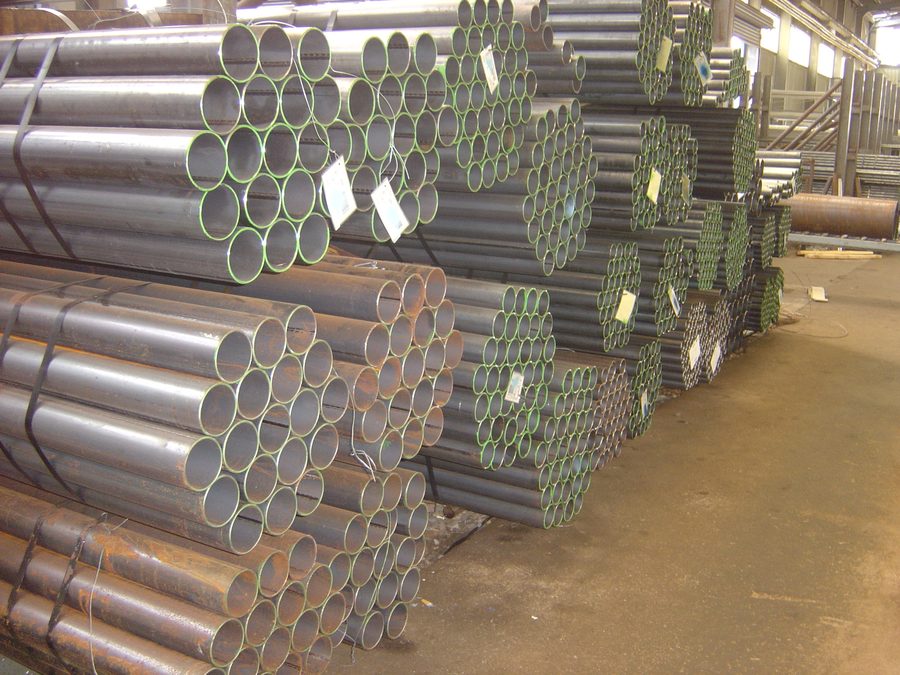
Seamless or welded: the basic choice
Seamless pipes are hot-pierced and rolled from a solid billet – they have no longitudinal weld; suitability nevertheless depends on material, manufacturing process, heat treatment and test category – a weld made and tested to the standard is not automatically a weak point in the circumferential direction. Welded pipes are made from strip or plate and are welded longitudinally or spirally. The usual selection logic in the trade:
Manufacture
Seamless (EN 10216)
The standard for high pressures and temperatures, thick-walled pipes and critical media; available in roughly 10.2–711 mm outside diameter.
Manufacture
Welded (EN 10217)
More economical for thin walls and large diameters; electrically welded (HFW) up to about 508 mm, submerged-arc welded (SAW, with longitudinal seam SAWL or spiral seam SAWH) from about 406 mm up to 2 540 mm – ranges customary in the market, not limits set by the standard.
Both seamless and welded pipes can be suitable for pressure-bearing applications if the applicable product and design standards are met – the choice depends on dimension, material, manufacturing process, test requirements, load spectrum, medium and project-specific approval. For high pressure, high temperatures, cyclic loading or sour gas (H₂S) practice often specifies seamless; what governs there, however, are the product standard and the sour-service requirements (for example hardness and test requirements to ISO 15156/NACE MR0175), which welded pipes can also meet. For standard process lines in the medium pressure range, modern HFI-welded pipe is usually the more economical solution. Above about DN 600 (24") the market in any case only offers welded pipe. Price relations depend on the market, the dimension and the quantity – only the actual quotation is reliable.
How pipes are made
The manufacturing process explains the properties – which is why it is part of every pipe designation:
- Seamless (S): A solid steel billet is pierced red-hot (cross-rolling, the Mannesmann process) and rolled to size on plug or mandrel mills. The mandrel process gives closer tolerances and smoother bores, the classic plug mill large quantities and thick walls.
- Electrically welded (ERW/HFI/HFW): Steel strip from the coil is formed into an open-seam tube; a high-frequency induction current heats the strip edges, which are pressed together without filler metal. Narrow heat-affected zone, uniform wall thickness – the standard process up to about 500 mm diameter.
- Submerged-arc welded (SAW): Plate is bent into a pipe by the JCOE process (J shape → C shape → O shape, then expanding) and welded inside and outside under flux (SAWL = longitudinal seam, SAWH = spiral seam). The process for large pipes from about 400 mm to over 2.5 m diameter; spiral-welded pipes are material-efficient but tend to be used for water rather than oil and gas lines.
At goods inward and on site: the heat number links the pipe to its inspection document – depending on product standard and delivery form it is marked on every length, on the bundle or on the label and the accompanying papers. If pipes are mixed in the warehouse, traceability is lost. This is where tidy certificate management saves real money.
The standard families: EN 10216 (seamless) and EN 10217 (welded)
Both series are built in parallel, and each replaces several old DIN standards. The parts differ by service temperature and type of steel:
| Service | seamless | welded | old DIN |
|---|---|---|---|
| Room temperature, non-alloy | EN 10216-1 | EN 10217-1 | 1629/1630 or 1626/1628 |
| Elevated temperatures | EN 10216-2 | EN 10217-2 (HFW), -5 (SAW) | 17175 or 17177 |
| Fine grain steels | EN 10216-3 | EN 10217-3 | 17179 or 17178 |
| Low temperatures | EN 10216-4 | EN 10217-4 (HFW), -6 (SAW) | 17173 or 17174 |
| Stainless steels | EN 10216-5 | EN 10217-7 | 17458/17459 or 17457 |
A memory aid for practice: part 1 = “normal”, part 2 = “hot”, part 3 = “strong”, part 4 = “cold”, parts 5/7 = “stainless”.
Dimension tables by standard
For each standard we maintain a dimension table of our own: outside diameter, wall thickness, weight per metre and the tolerances that belong to exactly this dimension – together 414 dimensions. So far the five tables are published in German only.
Which one is yours? That is decided by two questions before any number comes into play: seamless or welded, and what the pipe is used for. The table is sorted accordingly.
| Standard | Manufacture | What for | ⌀ (mm) | Wall thickness (mm) | Dimensions |
|---|---|---|---|---|---|
| EN 10217-1 | welded from strip, electrically (EW, HFW) | pressure lines at room temperature, plant construction, supply lines | 48.3–711 | 2.3–12.5 | 26 |
| EN 10217-7 | welded, stainless | process and media lines, food and chemical plants, plant construction | 17.2–508 | 1.6–5 | 75 |
| EN 10305-4 | seamless, cold drawn | hydraulic and pneumatic pressure lines, mechanical engineering and vehicles | 4–80 | 1–10 | 88 |
| EN 10216-5 | seamless, stainless | process and media lines, chemical and food plants, apparatus construction | 6–168.3 | 1–4.5 | 58 |
| EN 10216-2 | seamless, hot finished | boilers, steam and hot-water lines, plants at elevated temperatures | 13.5–610 | 1.8–28 | 167 |
The dimension ranges and the number of dimensions are counted from our dimension tables, not copied – they follow as soon as a table changes (state: 11 September 2026).
TR1/TR2 and TC1/TC2: the test categories
The EN pipe standards each know two levels of testing, and their abbreviations often cause confusion:
- TR1/TR2 (part 1, room temperature): TR1 without, TR2 with impact test (at 0 °C, optionally −10 °C). For pressure equipment under the Pressure Equipment Directive, TR2 is usually specified – what governs are the product standard, the material and the order.
- TC1/TC2 (parts 2–5): TC1 without, TC2 with ultrasonic testing for longitudinal imperfections. Alloy steels are generally supplied in TC2. Functionally, TC2 corresponds to the old distinction St 35.8 I (= TC1) versus St 35.8 III (= TC2).
For stainless steel line pipes, AD 2000 code of practice W2 governs the choice: up to 42.4 mm outside diameter and 3.6 mm wall, TC1 is sufficient, above that TC2 is required; shell pipes for pressure vessels always TC2.
Materials: from P235GH to P91
The material designation reveals the purpose: P = steel for pressure purposes, TR = room temperature, GH = elevated temperature, N = normalised (fine grain), L = low temperature. The grades usual on the market:
- Room temperature: P235TR1/TR2, P265TR1/TR2 (formerly St 37.0/44.0/37.4/44.4)
- Elevated temperature (boiler grades): P235GH (St 35.8), P265GH (St 45.8), 16Mo3 (15Mo3)
- Creep-resistant: 13CrMo4-5, 10CrMo9-10, 11CrMo9-10 up to the 9 % chromium steels X10CrMoVNb9-1 (“P91”) and X10CrWMoVNb9-2 (“P92”) for power plant construction
- Fine grain: P355N/NH/NL1/NL2, P460N series – higher yield strengths with good weldability
- Low temperature: P215NL, P255QL, 12Ni14, X12Ni5 for refrigeration plants
- Stainless: 1.4301, 1.4307, 1.4541, 1.4401, 1.4404, 1.4571 (the V2A/V4A series, ASTM counterparts TP304–TP316Ti), plus duplex 1.4462 and super duplex 1.4410
Threaded pipes are made of S195T (formerly St 33) – a plain steel suitable for welding and threading. Detailed material profiles with old and new designations are on our page Materials.
Boiler tubes: why they are a category of their own
“Boiler tubes” are seamless pipes to EN 10216-2 (formerly DIN 17175) in elevated-temperature grades, as installed in steam boilers, heat exchangers and power plants. They additionally exist in a dimension world of their own (31.8 / 38 / 44.5 / 57 / 63.5 / 70 / 108 / 133 / 159 / 193.7 mm …) that the normal ISO pipe series does not have. To avoid mix-ups, colour markings have become established in the trade (for example white = P235GH, yellow = P265GH, yellow/silver = 13CrMo4-5) – that is manufacturers’ practice, not part of the standard. Higher-alloy boiler grades are usually supplied with inspection certificate 3.2 (third-party acceptance, for example TÜV), standard grades with 3.1. Matching butt-welding elbows exist in the same boiler tube dimensions (boiler tube bends).
Threaded pipes to EN 10255
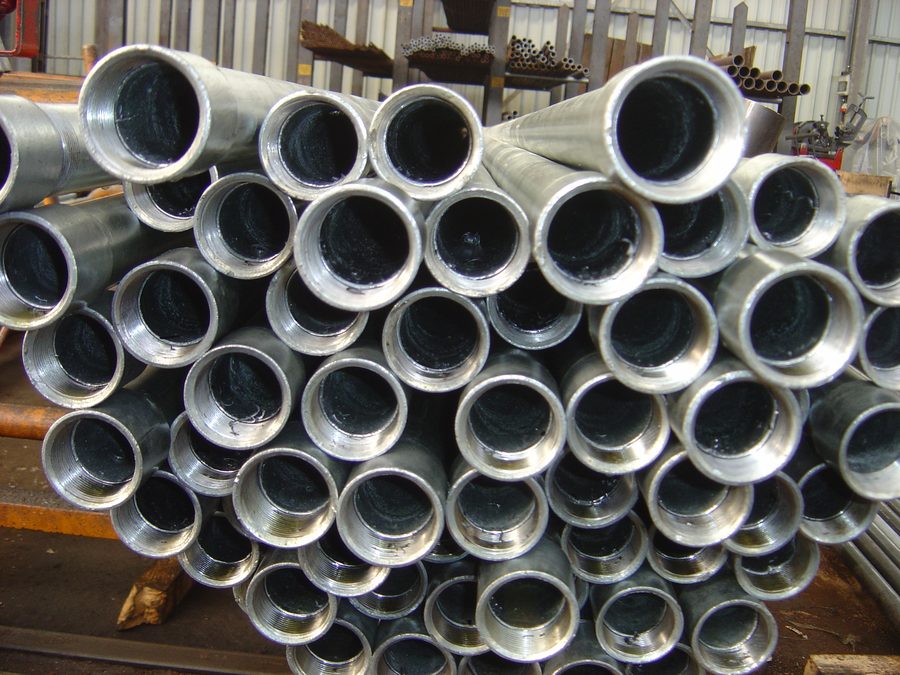
For heating, plumbing and simple media lines there is the threaded pipe family: pipes of S195T, suitable for welding and threading (Whitworth pipe thread to EN 10226/ISO 7-1). Two series:
- EN 10255-M (medium) – the successor of DIN 2440, the classic “gas pipe”; DN 8 (13.5 × 2.35) to DN 150 (165.1 × 4.85)
- EN 10255-H (heavy) – the successor of DIN 2441 with a thicker wall
Available black or hot-dip galvanised to EN 10240-A1 (formerly DIN 2444, coating thickness at least 55 µm inside and outside). Beware of a widespread error on the market: the assignment of M/H to DIN 2440/2441 is occasionally swapped even on distributors’ websites. The matching threaded fittings with R/Rp threads are explained on our page Malleable iron fittings.
Stainless steel pipes: delivery conditions and surfaces
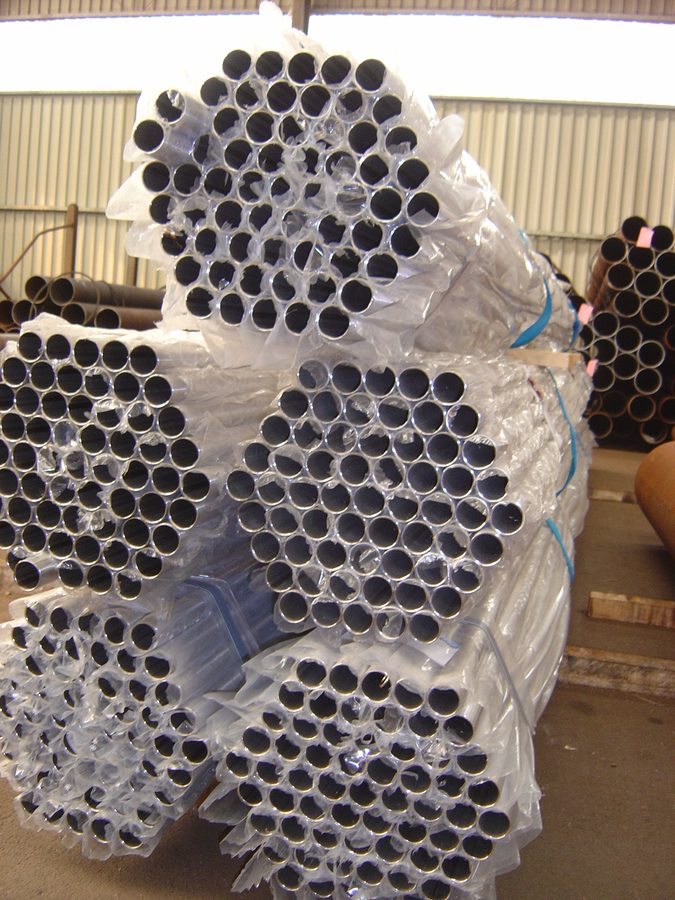
For welded stainless steel pipes, a system of abbreviations describes the delivery condition (EN 10217-7, formerly DIN 17457): W0/W1/W2 by starting material (hot- or cold-rolled strip) and pickling state, suffix A = heat treated, R = bright annealed, b = smoothed inside seam, WG = ground, WP = polished. Cold-rolled versions (W2…) give the smoother surfaces. For line pipes without pressure requirements there is, in parallel, EN 10296-2 (formerly DIN 17455) – important when comparing prices, because it is not interchangeable with the pressure pipe standard.
A pipe is not a pipe: line pipe, precision tube, tubing
In German everything is a “Rohr”; in international purchasing, however, “pipe” and “tube” are different products:
- Pipe (line pipe): transport of media, ordered by nominal size plus a wall thickness designation, comparatively loose tolerances, available from stock.
- Tube (precision or apparatus tube): heat exchangers, boilers, mechanical engineering; ordered by exact outside diameter and wall thickness, very close tolerances (cold drawn), usually made to order and more expensive. Heat exchanger tubes have to fit tube sheets – hence the close tolerances (in Germany for example to DIN 28180).
- Tubing (instrumentation tube): small diameters for measuring and hydraulic lines, joined by compression fittings.
The classic trap: a “2-inch pipe” has an outside diameter of 60.3 mm as pipe (NPS 2) but exactly 50.8 mm as tube – flanges, fittings and supports each fit only one of the two systems.
Dimension systems: EN 10220 vs NPS/schedule (ASME B36.10M/B36.19M)
In Europe a pipe is defined by outside diameter × wall thickness in mm (EN 10220, stainless steel also EN ISO 1127), in America by NPS (nominal pipe size) plus schedule. The important differences:
- The outside diameters are practically identical for the inch sizes (60.3 / 88.9 / 114.3 mm …) – an NPS 2 pipe matches a 60.3 mm EN pipe dimensionally.
- The schedule number is not a wall thickness: SCH 40 means 3.9 mm at 2" but 10.3 mm at 12". EN instead uses freely combinable wall thicknesses from a series of steps.
- STD = SCH 40 and XS = SCH 80 hold only up to NPS 10 – from NPS 12 the series diverge.
- Tolerances, tests and materials follow different sets of rules (EN 10216/10217 vs ASTM A53/A106/A312 …) – same dimensions does not mean same approval.
Two rules of thumb from our practice section go into more detail: DN is not a diameter and schedule is not a wall thickness.
Tolerances and testing (brief overview)
The usual minus tolerance on wall thickness is −12.5 % (which is why goods inward measures at several points around the circumference and at both ends). Stainless steel pipes to EN ISO 1127 are specified by tolerance classes D1–D4 (diameter) and T1–T4 (wall). Standard trade lengths: seamless 5–7 m, welded 6 m or 12 m; fixed and double lengths on request. Documents: test report 2.2 or inspection certificate 3.1/3.2 to EN 10204; for alloy boiler grades 3.2 with third-party acceptance is usual.
Our pipe programme: from stock and on request
As a technical wholesaler we carry the common steel and stainless steel pipes from stock and source a broad programme on request beyond that – from elevated-temperature EN grades and the ASTM programme to structural, mechanical engineering and precision steel tubes (state: July 2026, overview; availability per dimension is what counts).
| Type of pipe | Standard | Material / finish |
|---|---|---|
| Seamless steel pipes | EN 10216-2 | P235GH TC1 |
| Welded steel pipes | EN 10217-2 | P235GH TC1 |
| Seamless steel pipes, blast-cleaned to SA 2½ and coated to AGI Q 151 (2 × 80 µm) | EN 10216-1 | P235TR2 |
| Threaded pipes, black and galvanised, seamless and welded | similar to EN 10255 (M/S) | S195T |
| Seamless hydraulic tubes (Ermeto), black and galvanised | EN 10305-4 | E235+N |
| Welded steel pipes, powder-coated red RAL 3000, grooved | EN 10217-1 | P235TR1 |
| Copper tubes (TALOS®, RAL/DVGW), straight lengths, 12–22 also in coils | EN 1057 | Cu-DHP, 12–28 × 1.0 mm |
| Type of pipe | Standard | Materials |
|---|---|---|
| Welded stainless steel pipes | EN 10217-7 | 1.4301/1.4307, 1.4541, 1.4571, 1.4404 |
| Seamless stainless steel pipes | EN 10216-5 | 1.4301/1.4307, 1.4541, 1.4571, 1.4404 |
| Seamless stainless steel precision tubes | EN 10216-5 | 1.4301/1.4307, 1.4541, 1.4571, 1.4404 |
| Type of pipe | Standard | Materials |
|---|---|---|
| Seamless elevated-temperature steel pipes | EN 10216-2 | 16Mo3, 13CrMo4-5, 10CrMo9-10; P235GH TC2; P235GH/P265GH dual certified |
| Seamless steel pipes | EN 10210-1 / EN 10297-1 / EN 10216-3 | S355J2H / E355+N / P355N |
| Seamless fine grain steel pipes | EN 10216-3 | L360NE, P355NH, P355NL1, P355NL2 |
| Seamless pipes to ASTM (US programme) | ASTM A106 / A335 / A312 / A333 | A106 Gr. B (also dual certified with P265GH); A335 Gr. P11, P12, P22; A312 Gr. TP 304, 304L, 310, 316, 316Ti; A333 Gr. 6 |
| Welded structural steel tubes | EN 10219 | S235, S355 |
| Structural hollow sections | EN 10210-1 | S355J2H |
| Steel tubes for mechanical engineering | EN 10294-1 | E355, E470, E590K2 |
| Seamless fine grain structural steel tubes, high strength | EN 10297 | S690QL1, S770QL, S890QL1 |
| Seamless precision steel tubes | EN 10305-1 | E235+C/+N, E355+C/+N |
| Welded precision steel tubes | EN 10305-3 | E235 |
| Seamless hydraulic tubes (Ermeto), black and galvanised | EN 10305-4 | E355+N |
The overview shows the programme summarised in groups – we will gladly send the complete range list on request. For every item we supply the matching inspection document to EN 10204 (2.2, 3.1 or 3.2 with third-party acceptance) on request.
Frequently asked questions about steel pipes
What does “DN” mean for steel pipes?
DN is a standardised nominal size designation for piping components and not a directly measurable diameter. A steel pipe is therefore ordered by outside diameter × wall thickness in millimetres (dimension series EN 10220).
What does EN 10216 part 1 cover?
Part 1 covers seamless steel tubes for pressure purposes of non-alloy steels with specified room temperature properties – the successor of DIN 1629/1630, test categories TR1 (without) and TR2 (with impact test; for pressure equipment under the Pressure Equipment Directive TR2 is usually specified). Actual suitability additionally has to be checked against the piping calculation and the medium.
What is EN 10255 used for?
For non-alloy steel pipes (S195T) suitable for welding and threading in installation and threaded applications: medium series M (formerly DIN 2440) and heavy series H (formerly DIN 2441), black or hot-dip galvanised to EN 10240-A1. The standard number alone is not a sufficient order item – at least dimension, finish, length, surface, ends and inspection document belong to it.
How is the pipe material 1.4301 to be classified?
1.4301 is a general-purpose austenitic stainless steel, but without molybdenum. Selection must not be made by the word “stainless” alone; it has to take into account medium, chloride content, temperature, cleaning and the as-welded condition.
What does “seamless manufacture” mean for pipes?
The pipe is formed without a longitudinal weld from a solid or hollow starting material (cross-rolling, Mannesmann process). Seamless pipes are often specified for high pressure, high temperatures and sour gas applications – what governs are the product standard and the project-specific requirements (for H₂S for example ISO 15156/NACE MR0175).
Why is the order item “product standard” indispensable?
It defines the technical frame of the delivery – if it is missing, the delivery can be technically or documentarily unsuitable despite a similar designation. In practice we often receive inquiries naming only DN and pressure rating; for an unambiguous offer we additionally need product standard, dimension, material with test category, medium and temperature, and the inspection document required.
What is a declaration of compliance 2.1?
A confirmation that the delivery complies with the order, without test results. For orientation, the EN 10204 hierarchy: 2.1 (declaration of compliance), 2.2 (test report, non-specific results), 3.1 (specific inspection, validated by the manufacturer), 3.2 (additionally independent acceptance, for example TÜV). The level required follows from product standard, order and risk classification.
Pipes by standard and dimension – ask our warehouse
You need steel or stainless steel pipes to EN 10216, EN 10217 or EN 10255? Send us product standard, dimension, material with test category and the inspection document required – the items carried in stock from the stock programme we deliver at short notice from our warehouse, everything else we source on request. Our export team answers in English.
Send an inquiryTechnical basis: EN 10216-1 to -5, EN 10217-1 to -7, EN 10220, EN 10255, EN 10240, EN 10226/ISO 7-1, EN 10204, EN ISO 1127, AD 2000 code of practice W2, ASME B36.10M/B36.19M; stock programme from Zickwolff’s own range list (state July 2026). All information without guarantee – the current standard texts and the manufacturers’ technical data sheets always prevail.