Press systems · GF iFIT
GF iFIT: the push-fit system – d16 to d32 without a press machine
iFIT is GF's push-fit system for polybutene and multilayer composite pipe: chamfer the pipe, calibrate it, push it into the PPSU module – done. No press machine, no jaws, no profile. With the modular adapter technology one module covers two sizes, and according to the manufacturer the joint can be detached non-destructively and reused. This page explains pipe, sizes, availability, media with limits, detachability, transitions – and when a push-fit system is the better choice compared with pressing.
- Pipe
- Polybutene pipe (PB) · multilayer composite pipe PE-RT II/Al/PE-RT II
- Sizes
- d16–d32
- Modules
- PPSU, threaded parts brass / lead-free gunmetal
- Joint
- Push-fit: two O-rings, locking mechanism (no tool)
- Pressure / temperature
- PN 10 · 10 bar / 70 °C continuous operation, 50 years
- Availability
- from stock
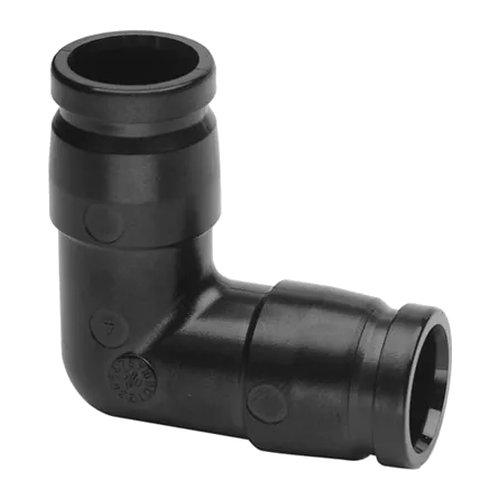
What iFIT is meant for – and where the limit lies
Drinking water, heating and air-conditioning installation on the floor level: connection lines, manifolds, radiator connections, bathrooms in series. GF names PN 10 at 10 bar, 70 °C and 50 years of continuous operation. The strength of the system is the workmanship: it needs no special technical knowledge and no press machine, which is why the same crew can carry out several trades – that is the reason iFIT is specified in prefabricated housing and in the refurbishment of large residential estates. The limit is part of it: d16 to d32, 70 °C, 10 bar. For risers of larger size, industrial applications, compressed air and gas iFIT is no substitute for a press or metal system.
How the push-fit joint works
The pipe is cut to length, chamfered and calibrated with the iFIT tool and pushed into the module up to the visible insertion depth. In the module a locking mechanism (grip ring) and two O-rings hold the joint – the grip ring against pull-out, the O-rings against pressure. There is no pressing; the joint is complete with the insertion. The modular adapter technology makes one module usable for two sizes (d16/d20 and d25/d32), which according to GF halves the range.
Because nothing is pressed, there is no “leaks when unpressed” profile either: the check is the visible insertion depth and the leak test. Both belong to the installation, not to the optional extras.
Pipe, sizes and availability
iFIT joins polybutene pipe (in coils, also in conduit) and multilayer composite pipe PE-RT II/Al/PE-RT II (straight lengths and coils, also pre-insulated). The table shows the four sizes; we stock iFIT.
| Size | Outside ø (mm) | DN | Availability |
|---|---|---|---|
| d 16 | 16 | 12 | in stock |
| d 20 | 20 | 15 | in stock |
| d 25 | 25 | 20 | in stock |
| d 32 | 32 | 25 | in stock |
The standard names dimensions. What is listed here, we carry – from stock or to order; how quickly something is available we clarify on request. From stock: modules (coupling, reducer, elbow, tee, threaded transitions, manifold, valve connection), pipe and tools – shop category fittings/plastic.
Which medium with which limits
GF names drinking water, heating and air conditioning with 10 bar and 70 °C. Cooling water is an open technical question; compressed air and gas are excluded.
| Medium | iFIT (O-ring) |
|---|---|
| drinking water | suitable 70 °C / 10 bar |
| heating water (closed circuit) | suitable 70 °C / 10 bar |
| cooling water | to be clarified |
| compressed air, oil-free | not suitable |
| natural gas (DVGW G 260) | not suitable |
Detachable and reusable – what that means
GF describes the iFIT modules as non-destructively demountable and reusable after installation: the pipe can be pulled out of the module with the release tool, and the module can be used again. That is a difference from every press joint, which can only be cut out, and an advantage for corrections during the fit-out and for conversions. We list the detachability as a manufacturer statement by GF. In the joining methods comparison push-fit therefore appears under the criterion detachability as “detachable (manufacturer statement)”.
What was learned from the early days of push-fit systems
That push-fit systems are less widespread in Germany than in other countries also has to do with their reputation from the early days. The early cases of damage at push-fit joints had typical causes: a pipe end that is not chamfered cuts into the O-ring when inserted; a pipe that is not calibrated is out of round and does not seal over the whole circumference; an insufficient insertion depth lets the pipe creep under pressure surges; pipes with too large a tolerance sit loosely; fittings without locking do not withstand tensile forces. Each of these causes has a design answer today – with iFIT like this: chamfering and calibrating are mandatory steps with the system tool, two O-rings seal, a locking mechanism holds the pipe against pull-out, the insertion depth is visible from outside, the sealing rings are fitted at the factory, and the system is approved for pipe and module together (DVGW). What remains is the care in preparing the pipe end: whoever chamfers, calibrates and inserts up to the mark gets a joint that is tested by the same rules as a press joint. Whoever skips a step has the same source of error as twenty years ago.
The second reason does not lie in the technology: the installer bears the warranty for a joint he will not see again later – and the press system gives him with “leaks when unpressed” a proof that the push-fit system does not have in this form; here the check is the visible insertion depth and the leak test. Add to that the press tools already in the business. Both explain the reserve better than any guess about motives – and neither speaks against the push-fit system where it belongs: on the floor level, in series, in refurbishment.
Transitions
Transition modules with male and female thread (brass, lead-free gunmetal), transition elbow modules, valve connection modules and manifold modules lead from iFIT to valves, threaded fittings and – via thread to EN 10226-1 – to all metal and press systems. Flow rule and material pairing as in every mixed installation.
Push-fit or press?
Pressing (Mepla, FlowFit, Raxofix) reaches up to d75, needs machine and jaws and is not detachable; push-fit (iFIT) ends at d32, needs only chamfering and calibrating tool and is detachable. Where speed, low demands on the installer and few tools count – prefabricated housing, bathrooms in series, refurbishment in occupied buildings – iFIT is the right choice; where sizes above d32, compressed air or industrial media are required, a press system. More under multilayer and push-fit systems and From our practice.
Installation in brief
- Cut the pipe square, chamfer and calibrate with the iFIT tool – without chamfering the O-rings suffer.
- Insert the pipe up to the visible insertion depth; pull briefly to check the seat of the grip ring.
- Leak test, record.
- Pipe routing with fixings after manufacturer statement; do not expose multilayer pipe permanently to daylight.
Availability at Zickwolff
The standard names dimensions. What is listed here, we carry – from stock or to order; how quickly something is available we clarify on request. We stock iFIT: modules, polybutene and multilayer pipe, tools.
Further reading
Tools of this section: system finder (which system suits medium, pipe and size) · joining methods compared (press, push-fit, grooved, welding, thread, flange, soldering) · cost comparison calculator (assembly time and downtime per method) · press systems overview.
Related multilayer and push-fit systems
| System | Pipe | Sizes | Availability |
|---|---|---|---|
| Viega Raxofix (multilayer composite pipe) | multilayer composite pipe | 16–63 mm | available to order |
| Geberit Mepla (multilayer composite pipe) | multilayer composite pipe | 16–75 mm | in stock 16–20; available to order 26–75 |
| Geberit FlowFit (multilayer composite pipe, lateral press technology) | multilayer composite pipe and polybutene pipe | 16–75 mm | in stock 16–25; available to order 32–75 |
| Uponor RS 63-110 (modular press and plug-in system, multilayer composite pipe) | multilayer composite pipe PE-RT/Al/PE-RT with welded aluminium layer (Uponor MLC 63-110) | 63–110 mm | available on request |
Matching items from our range: malleable iron fittings for threaded transitions, plastic piping systems by GF, valves.
Frequently asked questions about GF iFIT
Do I need a press machine for iFIT?
No. Chamfer the pipe, calibrate it, push it in – the chamfering and calibrating tool is the only tool.
Can I detach an iFIT joint again?
According to GF yes: the modules are non-destructively demountable and reusable (release tool). We list this as a manufacturer statement.
Which pipes is iFIT suitable for?
For iFIT polybutene pipe and iFIT multilayer composite pipe PE-RT II/Al/PE-RT II, d16–d32. Other pipes are not approved.
Up to how many degrees does iFIT go?
PN 10 at 10 bar and 70 °C in continuous operation over 50 years (manufacturer statement).
Does iFIT work for compressed air or gas?
No. iFIT is intended for drinking water, heating and air conditioning.
iFIT from stock
Tell us size and quantity – we deliver iFIT modules, pipe and tools from stock.
Send an inquiryYour inquiry to Zickwolff
Send us what you have – designation, standard, quantity, date. We will clarify the rest with you.
One item or a question
Send inquiry
Not in stock? We procure it – single items too.
Designation, standard and quantity are enough.
Several items
Send bill of materials
200 items? One parts list is enough – we deliver complete.
Attach it as a file.
Helpful if already known: project and country, date needed, certificates, packaging and language of the packing lists. If anything is missing, we will ask.
It is urgent
Request express
When do you need it? Express delivery, to the site if required.
Tell us by when you need the material – we will tell you what is possible.
Technical basis: GF iFIT brochure gfps-39052 (12/2023), GF iFIT delivery programme (07/2025), GF iFIT product line brochure (07/2025) – distributor material, use released; DVGW W 534, W 542. Availability after Zickwolff merchandise management (09/2026). The binding approval stays with the manufacturer.