Additive manufacturing · Processes and materials
Additive manufacturing: processes and materials – what lies behind the words 3D printing
“3D printing” is a collective term for seven process families that differ in energy source, feedstock, build volume, deposition rate and surface as much as forging differs from casting. For piping, five metal processes count: laser powder bed fusion, electron beam fusion, directed energy deposition with powder or wire, and binder jetting. This page explains them in plain language, says which materials they process, why a printed 1.4404 is not the same material as a forged one – and where additive manufacturing has its strength. At the end: plastic 3D printing, which has long since arrived on site and in the warehouse.
- Standard
- ISO/ASTM 52900 (terminology, seven categories)
- Metal processes
- PBF-LB/M · PBF-EB/M · DED-LB · DED-Arc (WAAM) · BJT/M
- Materials
- 1.4404, 1.4542, nickel base, titanium, aluminium; wire: structural steel, stainless steel, duplex
- Build volume
- Powder bed small to medium · deposition welding large
- Post-processing
- Heat treatment, support removal, machining, optionally HIP
- Plastics
- MEX (FDM), laser sintering – only gauges, models, brackets
What additive manufacturing is
Additive manufacturing builds a component layer by layer from a digital model – material is added, not removed as in turning or milling and not formed as in forging. ISO/ASTM 52900 sorts all processes into seven categories: powder bed fusion (PBF), directed energy deposition (DED), binder jetting (BJT), material extrusion (MEX), material jetting (MJT), sheet lamination (SHL) and vat photopolymerisation (VPP). The abbreviation names category, energy source and material: PBF-LB/M is powder bed fusion with laser beam in metal, DED-Arc is directed energy deposition with an arc. Whoever reads a quotation or an appraisal needs these abbreviations – they are listed in our glossary.
The material carries the same number – and is still a different one. A component made of 1.4404, fused in the powder bed, has the same chemical composition as a forged piece of 1.4404. But it is a different material condition: solidified layer by layer, with direction-dependent properties (anisotropy), residual stresses, residual porosity and a surface that has to be machined. There is no product standard for it such as EN 10222 for forgings or EN 10216 for pipes – which is exactly why the printed pressure-retaining part needs a particular material appraisal (see Rules and approval). Heat treatment and hot isostatic pressing (HIP) even out a great deal, but do not replace the product standard.
The five metal processes compared
The table sets the metal processes side by side – energy source, feedstock, strength and limit. What is missing is left out deliberately: manufacturer names of machines, and prices. Orders of magnitude for build volume and deposition rate are general knowledge of the process family, not manufacturer values.
| Process | Abbreviation | Energy | Feedstock | Strength | Limit |
|---|---|---|---|---|---|
| laser powder bed fusion (metal) | PBF-LB/M | Laser | Metallpulver | complex internal channels, thin walls, small series and one-offs with high geometric freedom | build volume, low deposition rate, powder cost, residual porosity and anisotropy without HIP |
| electron beam powder bed fusion (metal) | PBF-EB/M | Elektronenstrahl (Vakuum) | Metallpulver | preheated build (low residual stress), reactive alloys such as titanium in vacuum | few steel alloys qualified, coarse surface, small market for piping components |
| laser directed energy deposition (powder) | DED-LB/M (Pulver) | Laser | Metallpulver (Duese) | repair and build-up on existing parts, cladding, gradient materials, large parts | no fine internal geometry, dilution with the base material, machining always required |
| wire arc additive manufacturing | DED-Arc (WAAM) | Lichtbogen (MSG, WIG, Plasma) | Schweissdraht | large parts at low material cost, weld-qualified wires, ASME Code Case 3020 and API 20S cover it | coarse resolution, high heat input and distortion, no thin walls or internal channels |
| binder jetting (metal, sintered) | BJT/M | Bindemittel + Sinterofen | Metallpulver | series of small parts at low cost, no support structures | sinter shrinkage and porosity, limited size, no pressure-equipment qualification known |
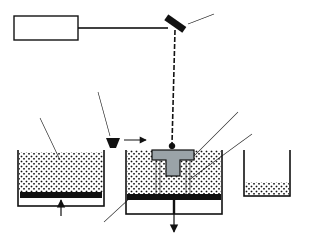
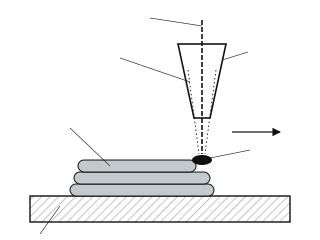
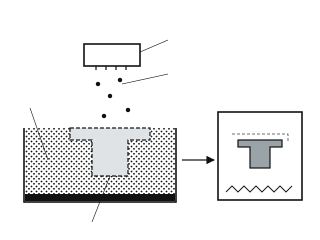
Powder bed fusion with laser (PBF-LB/M)
The process behind most certified pressure equipment parts: a laser fuses metal powder layer by layer in a build volume of typically up to about 400 mm edge length. It can make internal channels, thin walls and lattice structures that no other process reaches – and it is slow, expensive per kilogram and needs support structures, heat treatment and machining of the functional surfaces. Residual porosity and anisotropy cannot be argued away without HIP; the inspection of internal flaws calls for computed tomography where ultrasonic testing fails on the rough surface.
Electron beam fusion (PBF-EB/M)
The electron beam works in a vacuum with a preheated powder bed – low residual stresses, good for titanium and reactive alloys. For steel few alloys are qualified, the surface is coarser; in piping it hardly plays a role.
Directed energy deposition with powder (DED-LB) and with wire (DED-Arc, WAAM)
Deposition welding is the oldest additive manufacturing: a laser or an arc melts powder or wire onto a base part or a base plate. With laser and powder, seats, stems and wear surfaces are repaired and clad – precisely, with low heat input. With arc and wire (WAAM), large steel parts are produced at low material cost: blanks, nozzles, special parts a metre long, from welding-qualified wires – coarse, with high heat input and distortion, always with machining of all functional surfaces. Because it is welding, the rules of welding apply; in the ASME world, Code Case 3020 covers wire arc deposition for pressure-retaining parts.
Binder jetting (BJT/M)
A binder glues powder into a green part, which is then sintered. Fast and cheap for series of small parts, without support structures – but with 15 to 20 % sintering shrinkage, residual porosity and limited size. For pressure-retaining piping parts no qualification is known.
Where additive manufacturing has its strength – and where not
Its strength: the single piece and the small series for which no tooling and no forging dies pay off; components with internal channels that cannot be drilled (manifolds, heat exchanger cores, cooling channels in housings); weight saving through lattice structures; the spare part for which the manufacturer no longer has tooling; the repair on the existing part. Its weakness: everything that is rolled, drawn, forged or cast in volume – that is, almost everything in piping that has a product standard. Long, slender geometries such as pipes fit into no build volume; rotationally symmetrical parts such as reducers are turned on the lathe denser, faster and cheaper. The price per kilogram of printed material lies orders of magnitude above that of rolled material – how far depends on material, process and post-processing and belongs in the calculation of the individual case.
Who actually prints? Pump and valve manufacturers for their own parts – KSB has operated additive manufacturing since 2003 and has been certified by TÜV SÜD since 2020 for the additive manufacturing of components under the Pressure Equipment Directive, with impellers, housings with heating channels and spare parts as use cases. Alongside them, printing service providers, the maintenance departments of large operators, shipyards and research institutions. The technical wholesaler does not print: its job is the standardised part from stock – and the knowledge of when that is the better choice.
Plastic 3D printing in piping: gauges yes, pipework no
The printer with plastic filament (material extrusion, FDM) or the laser sintering of polyamide stands in many workshops – and makes sense there: drilling jigs and marking templates, trial pieces to hold against the existing installation, models for the discussion with the customer, brackets and protective caps for flanges and pipe ends in the warehouse. What does not work: printed fittings for pressure lines. They are not pressure-tight (layer adhesion, porosity), not creep-resistant under sustained load and temperature, and they have no approval – neither from DVGW nor under the Drinking Water Ordinance. Whoever needs plastic piping systems finds them as tested systems in the GF plastic systems: PP, PE, PVDF and ABS with fittings, jointing technology and approval from one source.
| Process | Abbreviation | Feedstock | Strength | Limit |
|---|---|---|---|---|
| material extrusion (thermoplastics) | MEX/P (FDM) | Kunststofffilament (PLA, PETG, PA, PP) | jigs, templates, models, holders and protective caps for the site and the warehouse | not pressure-tight, not creep-resistant, not approved for pressure pipework or drinking water |
| laser sintering (polymers) | PBF-LB/P (SLS) | Kunststoffpulver (PA 12, PA 11) | functional plastic parts without supports, small series | same limits as material extrusion for pressure and drinking water |
Further reading
This topic: Additive manufacturing in piping · Metal and steel: component classes · Rules and approval · Suitability matrix · Enquiry helper for special parts.
From our range: Materials · Certificates to EN 10204 · Test methods · Guide to standards · Flanges · Valves.
Frequently asked questions on processes and materials
What does PBF-LB/M mean?
Powder bed fusion with laser beam in metal – the abbreviation to ISO/ASTM 52900. Colloquially laser melting or SLM.
Is WAAM welding or printing?
Both: wire arc deposition is additive manufacturing (DED-Arc) and at the same time welding – which is why welding procedure qualification, welder qualification and non-destructive testing apply as on a weld seam.
Can duplex or nickel-base alloys be printed?
Yes – as powder in the powder bed and in laser deposition, as wire in arc deposition. The question is not whether it works, but which properties the printed condition has and who certifies them.
What is HIP?
Hot isostatic pressing: the component is densified afterwards under high gas pressure and high temperature, residual pores close. For printed pressure-retaining parts often part of the qualification.
May I install printed plastic parts in the line?
No – not in pressure lines and not in drinking water. For gauges, models, brackets and protective caps they are well suited.
Material and product form from one source
Tell us material, product form and size – we supply forgings, pipes, fittings and flanges certified to EN 10204, from stock or to order.
Send an inquiryYour inquiry to Zickwolff
Send us what you have – designation, standard, quantity, date. We will clarify the rest with you.
One item or a question
Send inquiry
Not in stock? We procure it – single items too.
Designation, standard and quantity are enough.
Several items
Send bill of materials
200 items? One parts list is enough – we deliver complete.
Attach it as a file.
Helpful if already known: project and country, date needed, certificates, packaging and language of the packing lists. If anything is missing, we will ask.
It is urgent
Request express
When do you need it? Express delivery, to the site if required.
Tell us by when you need the material – we will tell you what is possible.
Technical basis: ISO/ASTM 52900 (terminology), DIN/TS 17026:2020-10 and E DIN EN 13445-14:2025-01 (scopes), Directive 2014/68/EU Annex I No. 4, EN 1092-1, EN 10253, EN 10216/10217, EN 10204, ASME PTB-13-2021, API Std 20S (2025), DNV-ST-B203 (2025), UBA assessment basis for metallic materials (2026) – each from the freely accessible scopes and legal texts; manufacturer statement KSB on certified production (2020). Suitability assessments are ours; the binding assessment of a pressure-retaining part lies with the notified body and the manufacturer. No prices, no delivery promise. Information without guarantee.