Standards guide · Tees
Tees: standards, equal and reducing designs, selection
A tee is a butt-welding fitting that branches a pipeline at 90°. This page places the standards EN 10253 and DIN 2615, explains the designs “equal” and “with reducing branch” and summarises centre-to-end dimensions, tolerances and the comparison with ASME B16.9.
- Standard
- EN 10253-2 / -4
- Replaces
- DIN 2615
- Branch
- 90°
- Designs
- equal / reducing
Dimension finder
Steel tees – EN 10253-2
Dimensioned drawing and full dimension tables for every size, type A/B, tolerances.
Dimension finder
Stainless steel tees – EN 10253-4
Dimensioned drawing and full dimension tables for every size, type A/B, tolerances.
What is a tee?
A tee is a butt-welding fitting that branches a pipeline at 90°. As starting material EN 10253 permits seamless tube, welded tube, plate and strip, forgings and bars (table 1). Depending on the process, the branch is formed from the tube wall or made by welding in a second tube – the one says nothing about the other. The part is installed with all three ends butt-welded.
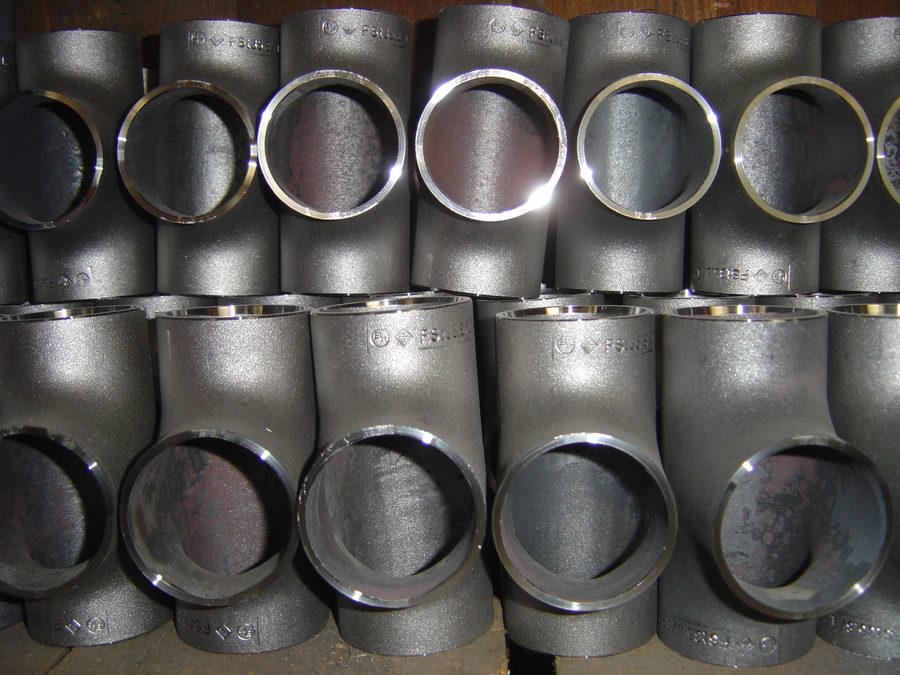
The two basic designs
“Drawn” does not mean “seamless”. For a tee, “drawn” describes how the branch was made – the tube wall is opened and the branch is drawn out of it. Whether the tube was seamless or welded is a separate question. Why the two words are nevertheless constantly confused on the market is explained under words that get mixed up on the market.
Design
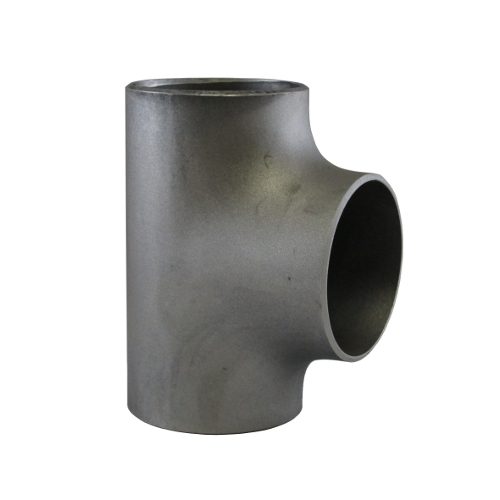
Equal tee
Run and branch have the same nominal size.
Design
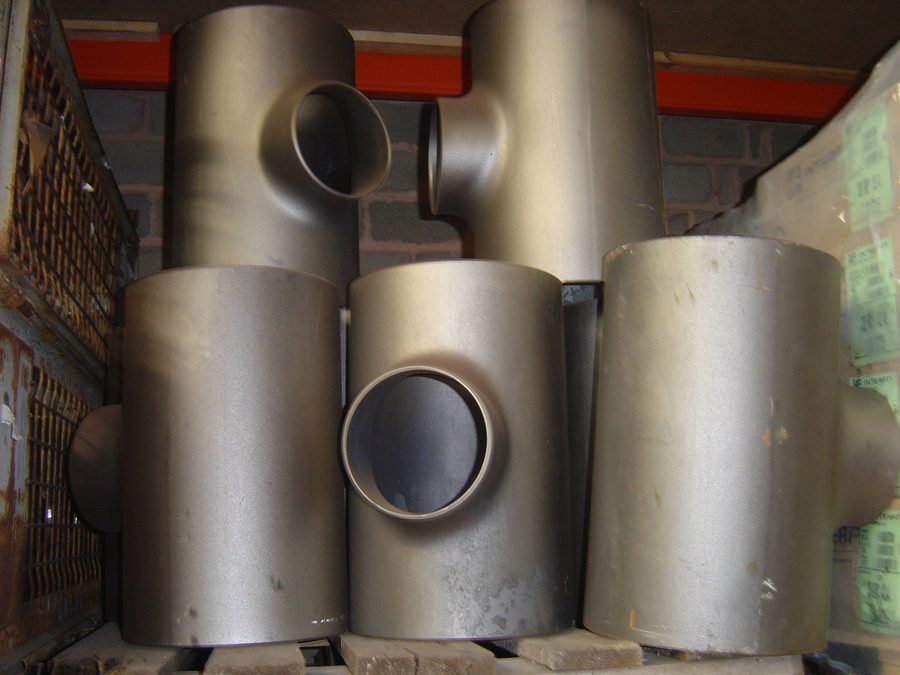
Reducing tee
The branch is smaller than the run. Orientation from advisory practice: if the branch is more than two or three nominal sizes below the run, it is worth comparing with branch fittings (for example weldolets to MSS SP-97) or saddle outlets – depending on the application these are more favourable for flow and more economical. This is not a general rule of the standard; what governs are range, application and the applicable piping code.
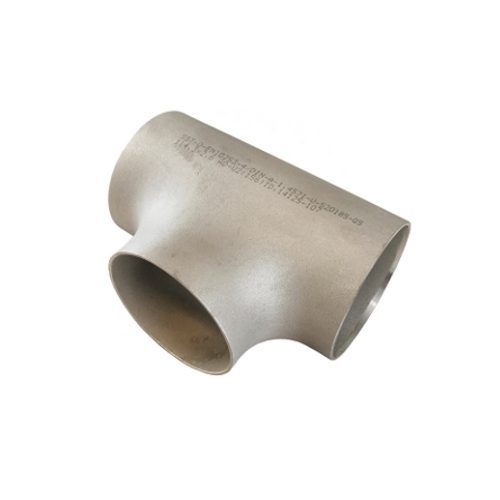
A special design from pipeline engineering: the “barred tee” with an internal bar grid in the branch that prevents pigs from entering the branch – usual as an equal tee only.
Standards: from DIN 2615 to EN 10253
The old DIN 2615 (part 1 = reduced, part 2 = full pressure factor) has been absorbed into EN 10253:
- Steel: EN 10253-2, type A (≈ DIN 2615-1) and type B (≈ DIN 2615-2)
- Stainless steel: EN 10253-4 (materials for example 1.4541, 1.4571), seamless (S) or welded (W)
The short designation EN 10253-2 form A on product pages denotes type A (reduced pressure factor). The sister fitting of the same standard family is explained on the page Reducers; the systematics of EN 10253 and its four parts are covered on our elbow pages (German so far).
Words that get mixed up on the market
With tees, inquiry, quotation and certificate talk past each other more often, in our experience, than with any other fitting. That is not the fault of the people involved: there are six symbols and words that mean something different depending on their reference – five in usage, the sixth in the standard itself. We separate them here – with the reference, so that everyone can look it up.
1. “Drawn” – the wall or the tube?
For a tube, “drawn” (cold drawn) is a manufacturing step that has nothing to do with seamless: there are seamless cold drawn tubes and welded cold drawn tubes side by side.
For a tee, “drawn branch” means something else: the tube wall of the run is opened and the branch is drawn out of it. The part remains in one piece; no second tube is added.
That is why “drawn” is not the opposite of “welded”. A manufacturer can take a welded tube and draw the branch from it – then both are true at the same time.
2. Drawn, necked, set-on – three stages, not two
Between “fully drawn out” and “tube welded on” lies a third stage, very common in practice: necking. Here the edge of the wall cut-out is raised only a short way, and the branch tube is welded onto the neck thus formed. The advantage: the weld lies in one plane (V-weld) and can be radiographed well.
- drawn – branch formed entirely from the wall, no second tube
- necked, V-welded – neck formed, branch tube on top, V-weld in one plane
- circumferentially welded – branch tube set on or into the bare wall cut-out, circumferential weld
Exactly these three stages are listed by EN 10253-4:2025 as designs of their own (figures 6 to 8). That is also where the “V” in “V-welded” comes from – it is the weld shape of the necking.
3. “Bauart” – the German word changed its meaning in 2025
In the 2008 edition of the German version, Bauart stood for the pressure factor, that is for A or B. Since the 2025 edition that is called Typ (type), and Bauart denotes the design – for an elbow the bend radius, for a reducer concentric or eccentric, for a tee the three branch designs above.
Whoever works with an older catalogue, an old drawing or the predecessor standard therefore means something else by the same word. In case of doubt, ask whether A/B is meant or the design.
4. “Welded” – the branch or the whole part?
“Welded” can mean two things:
- the branch is welded in (design), or
- the fitting counts as welded – marking W.
And the second is wider than most people expect: according to EN 10253 a fitting is a welded fitting even if no welding was ever done – it is enough that the starting tube has a seam. Conversely, a part made from seamless tube counts as welded as soon as welding takes place during manufacture.
In addition: unless the order specifies otherwise, the standard expressly leaves the choice between seamless and welded tube to the manufacturer. Whoever needs S has to order it – otherwise what the manufacturer uses is delivered. On the part itself, W must be marked, S is optional.
5. “Egal” or “equal” – the same part
In the German trade the tee with a branch of the same size is almost always called “egal” (from the English equal tee). The standard says “tee with equal outlet”. Both are the same part – you will find it with us under both words.
The standard does not even list “equal” and “reducing” as a feature of its own: it decides this by the dimension designation. If only one pair of dimensions is given (D × T), an equal tee is meant; a second pair turns it into a reducing tee.
6. “X” – two different quantities, one letter
This is no confusion of the market but one of the standard itself: EN 10253 uses the letter X twice. In the list of symbols it stands for the limit deviations of the fitting geometry – the permissible deviation from squareness and alignment, measured according to figure 9 of the standard. In annex B, however, the same X stands for the pressure factor, that is the ratio of the pressure strength of the fitting to that of a straight pipe.
When you read “X = 94 %” on our pages, the pressure factor is always meant – a percentage. The geometric deviation is a millimetre value and stands in our tolerance block under “selected dimensions and form tolerance”. Whoever looks it up in the symbol list of the standard, however, finds the other X first.
It is not only the market. The standard itself is not entirely consistent here either: the same clause 11.1.3 of DIN EN 10253-4:2025 speaks once of the “welded-on” and once of the “welded” branch. And the standards brochure of a fittings manufacturer expressly points out that the English terms type and model were translated inconsistently in part 2 and part 4. If you feel unsure at this point, you are in good company.
Technical basis of this section: DIN EN 10253-2:2026-07 and DIN EN 10253-4:2025-10, in each case clause 3 (terms), 5.3 (designation), 8.2 (manufacturing process, table 1), 11.1.3 and 15 (marking); figures 4 to 8 of part 4. Description of the manufacturing stages after Rohrleitungen – Grundlagen, Planung, Montage, p. 189. Evidence of seamless as well as welded cold drawn tubes: Tabellenbuch für den Rohrleitungsbau, pp. 72/73. Change of meaning of “Bauart” after the comparison EN 10253-4:2008/2025 by the German steel trade association BDS. Note on the translation of type and model: ERNE FITTINGS, standards brochure 03/2018.
Centre-to-end dimensions and geometry
The standard defines the installation dimensions per size (dimension letters to EN 10253): F = centre to end of the run, G = centre to end of the branch. For the equal tee F = G; for the reducing tee F stays constant and G decreases with the nominal size of the branch.
A manufacturing detail: necking stretches the side wall; for cold formed tees to EN 10253-2 the standard therefore requires a surface crack test (penetrant or magnetic particle testing) of the side wall areas.
Tolerances (brief overview EN 10253)
Flow: at least 70 % of the theoretical inside diameter (stricter than for elbows and reducers with 80 %, because necking constricts the cross-section). Minus tolerance on wall thickness −12.5 %. From about 3 mm wall thickness supplied with a welding bevel (30°, root face 1.6 ± 0.8 mm); the details of the end preparation (bevel or square) are governed by the applicable edition of the standard and the order agreement.
EN ↔ ASME
To ASME B16.9 the designs are called equal/straight tee and reducing tee. For inch sizes the centre-to-end dimensions are practically identical with the EN dimensions (8″: 177.8 mm ASME vs 178 mm EN); differences: ASME wall thicknesses follow schedules, and EN additionally standardises purely metric sizes (57; 76.1; 108; 133; 139.7; 159 mm etc.) that ASME does not know. On the material side, ASTM A234 WPB and P235GH or A403 WP316Ti and 1.4571 are product-form-specific orientations – not automatically equivalent or interchangeable.
Frequently asked questions about tees
What is an equal tee?
A tee in which all three ends have the same outside diameter. The selection has to be coordinated with the design calculation and the fabrication code.
What does EN 10253-1 mean for tees?
Part 1 stands for non-alloy steel without specific inspection requirements; the standard in plant construction is part 2 (form A/B). In addition, equal or reducing, run and branch dimensions and wall thicknesses have to be specified.
Why are “standard and type A/B” required for a tee?
The information defines the pressure and testing concept: type A = same wall thickness as the connecting pipe (reduced pressure factor), type B = reinforced (full pressure resistance (wall thickness to EN 10253)). Without it the selection is not unambiguous.
How is a seamless tee defined?
Without a manufacturing weld in the body of the fitting; the manufacturing process influences properties, tests and marking.
How is the designation “DIN 2615” to be classified?
A historical national tee standard, replaced by EN 10253 (DIN 2615-1 ≈ type/form A). Today's solution is determined by EN 10253-2/-4 and the piping calculation.
What has to be considered for the orientation of the branch?
Position in the plant and accessibility; installation must not force the fitting into position.
Find the matching tee directly
You already know design, dimension and material? In the Zickwolff range you will find tees for steel and stainless steel lines directly – our export team answers inquiries in English.
Technical basis: EN 10253-2 and -4 (formerly DIN 2615), ASME B16.9, MSS SP-97. All information without guarantee – the current standard texts and the manufacturers’ technical data sheets always prevail.