Selection guide · Pipe end closures
Closing a pipe end: cap, dished end, blind flange, plug or spectacle blind
Closing a pipe end is not a question of dimensions but of intent. Five components come into question, and they differ less in what they cost than in what they allow later on. This page places them side by side – and says what the standard regulates and what it expressly leaves open.
Closing a pipe end: cap, dished end, blind flange, plug, spectacle blind – or just a protection cap?
A pipe end can be closed in six ways, and none of them is “the right one” – each answers a different question. Three questions are enough to narrow the choice down to one or two parts:
- Permanently tight – or to be reopened? Welded (cap, dished end) is final; blind flange, threaded closure and spade are removable. If it is only about dirt during transport and storage, the plastic protection cap will do.
- Must the point be blocked off during operation? Then it is not a closure but an isolation: the spade or spectacle blind for safe, visible isolation during maintenance – or a valve if the line is switched regularly; the economical design for that is the butterfly valve, which we hold in stock.
- How large is the nominal size? Threaded closures end at 4 inches, spades become heavy at large nominal sizes; caps, dished ends and blind flanges are in our dimension tables up to ⌀ 1 219 or 610 and DN 800 – above that to customer specification.
The six closures compared
| Feature | Cap | Dished end (torispherical head) | Blind flange | Plug / threaded cap / screw plug | Spade / spectacle blind | Protection cap / protection plug (plastic) |
|---|---|---|---|---|---|---|
| Picture | 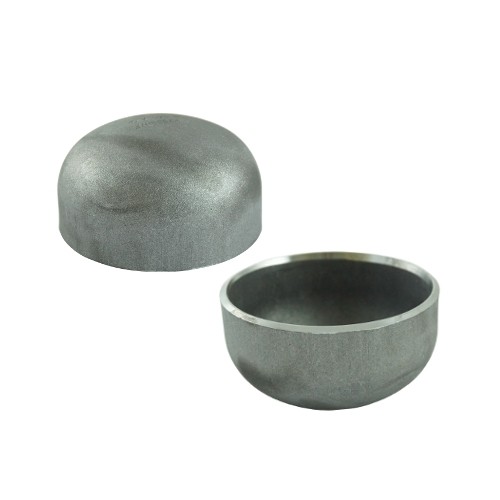 |
– | – |   |
 |
– |
| Standardised in | EN 10253-2 (steel), EN 10253-4 (stainless); formerly DIN 2617 | DIN 28011 (torispherical head, vessel construction); as fitting “end” EN 10253-4 | EN 1092-1 type 05; formerly DIN 2527 | Threaded fittings: EN 10242 (malleable cast iron), ISO 4144 / EN 10241 (stainless steel), thread EN 10226-1 | no EN standard; ASME B16.48 | not standardised |
| Connection | butt-welded in EN 10253, 11.3 | welded in EN 10253-4, 11.1.5; DIN 28011 | bolted – needs a welding neck or loose flange on the pipe EN 1092-1 | thread: the plug screws into the pipe (internal thread), the threaded cap onto the external thread of the pipe | between two flanges, two gaskets | pushed on or in, without tools |
| Reopenable? | no – only by cutting | no – only by cutting, like the cap | yes | yes | yes, alternately open/closed with visible position | yes, by hand |
| Size range | ⌀ 21.3 – 1 219 in our dimension tables; larger to customer specification, pressed in the head-forming shop Table A.4 / A.12 | ⌀ 17.2 – 610 as a fitting to EN 10253-4; as a torispherical head to DIN 28011 up to ⌀ 8 000, above that by agreement Table A.13 / A.14; DIN 28011 | DN 10 – 800 in our dimension tables; the standard gives the plate thickness of type 05 for PN 6 up to DN 2 000, PN 10 up to DN 1 200, PN 16 up to DN 1 000, PN 25 and PN 40 up to DN 600 – above that to be specified by the purchaser; larger still to customer drawing EN 1092-1, Tables 11–15 | up to 4 inches | ½ – 24 inches; large nominal sizes as a separate spade | to pipe outside or inside diameter |
| Height at the pipe end | high – e.g. ⌀ 219.1 → 102 mm Table A.12 | low – e.g. ⌀ 219.1 → 62.5 mm Table A.13 | plate thickness plus flange and bolts, e.g. DN 200 PN 16: plate 24 mm EN 1092-1, Table 12 | minimal | plate thickness; the spectacle needs room to swing | small |
| Pressure | carries the pipe pressure – type A or type B (reinforced body) EN 10253, 5.3.5, Annex C/D | no calculation rule in the standard – responsibility of the user EN 10253-4, 11.1.5 Note 2 | by pressure rating PN EN 1092-1 | as specified by the manufacturer | by flange class; thickness rule | pressureless – dirt and transport protection only, no closure under pressure |
| Material | steel, stainless steel | steel and stainless steel (DIN 28011); as an EN 10253 fitting stainless only DIN 28011 | all material groups of EN 1092-1 | malleable cast iron, stainless steel | as flange and pipe | plastic (PE) |
| Typical use | line end, nozzle closure, header | vessel and apparatus head, low pipe closure | inspection, cleaning, later extension, pressure test | drain, measuring nozzle, small branches | safe isolation during maintenance, blocking during operation | transport, storage, site – keeps dirt out of the pipe |
| Cost | low | low | higher – flange, gasket and bolts come on top | low | heavy and expensive at large nominal sizes | very low |
Standard references: DIN EN 10253-2:2026-07 and DIN EN 10253-4:2025-10 (caps, dished ends), DIN EN 1092-1:2018-12 (blind flanges), DIN 28011. Use, installation and cost information from Zickwolff trading practice and specialist sources on piping construction (as of August 2026).
Pros and cons
Cap
Permanently closed – the compact solution
- tight, compact, inexpensive – welded like a fitting
- type A or type B selectable: type B reinforces the wall at the body, because the knuckle is the weak point EN 10253, 5.3.5, Annex B/C/D
- opened only by cutting, no access
- higher than the dished end (long straight flange) A.12 against A.13
Dished end (torispherical head)
Low and from vessel construction
- low height, torispherical form DIN 28011 – available in steel and stainless steel Figure 14; DIN 28011
- standardised as a fitting of EN 10253-4 (Part 2 does not know it) 11.1.5
- permanently tight like the cap, opened only by cutting
- no calculation rule and no pressure factor in EN 10253 11.1.5 Note 2, C.5 Note
Blind flange
Open occasionally
- removable – inspection, cleaning, later extension, pressure test
- all pressure ratings, all material groups EN 1092-1
- needs a flange on the pipe, gasket and bolts – cost and weight
- no visible position indication, every opening loosens all bolts
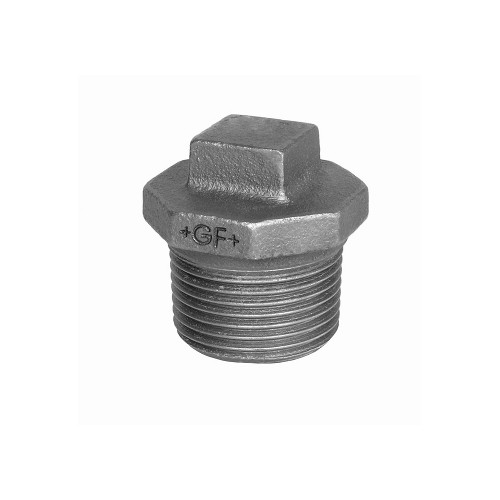
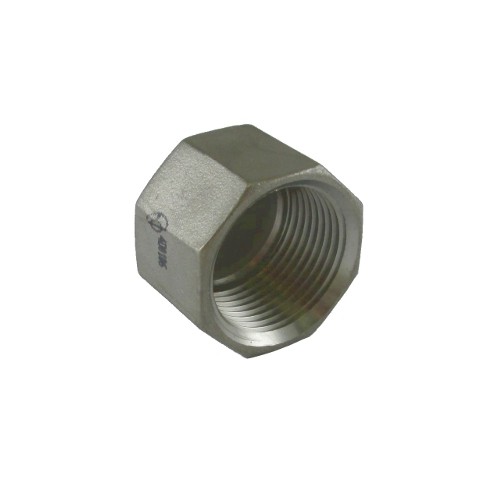
Plug / threaded cap / screw plug
Small, without welding
- smallest solution, removable, no welding
- two forms: the plug with external thread screws into the pipe (internal thread), the threaded cap with internal thread onto the external thread of the pipe
- small nominal sizes only; thread sealing
- pressure suitability as specified by the manufacturer
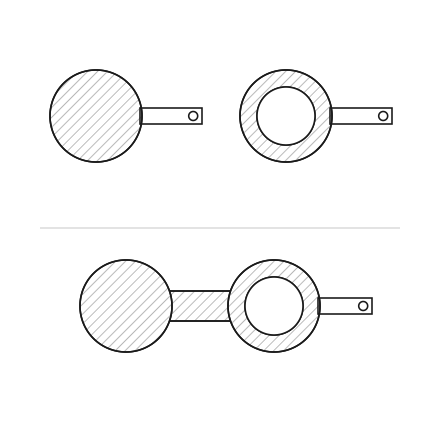
Spade / spectacle blind
Blocking during operation, visibly
- safe isolation, position recognisable from outside, cheaper than a valve
- whoever switches the point regularly takes a valve instead of the spade – the butterfly valve (EN 593) is the economical, short-pattern design, which we hold in stock
- two gaskets, repositioning only without pressure
- the spectacle needs room to swing; heavy at large nominal sizes – then separate spade and spacer ring
Protection cap / protection plug (plastic)
Not a closure – a protection
- keeps dirt and foreign bodies out of the pipe during transport, storage and on site
- pushed on and taken off by hand, very inexpensive
- pressureless – replaces none of the five other closures
- often called “pipe cap” or “end cap” on the market and confused with the welding cap
What the standard says – and what it does not. EN 10253-4 designates the cap (“cap”) and the dished end (“end”) by design, type A/B, outside diameter and wall thickness; Part 2 knows only the cap. For dished ends the standard expressly gives no calculation rule, and the pressure factors of Table C.5 do not apply to them. Some dimensions do not meet all technical rules, for instance EN 13480-3 – they are customary standard dimensions to be agreed. The flow criterion and waviness do not apply to caps and dished ends. DIN 28011 (torispherical form) and DIN 28013 (semi-ellipsoidal form) are vessel-head standards; here they serve only to compare the forms.
Terms that get mixed up on the market
- Cap · welding cap · head
- the same part: the welded-in closure to EN 10253 (“cap”), in trade often still “cap DIN 2617”.
- Dished end · torispherical head (Klöpperboden)
- the low closure to EN 10253-4 (“end”) or the vessel head DIN 28011 – same form, two standards.
- Semi-ellipsoidal head (Korbbogenboden)
- deeper dished vessel head DIN 28013; the calculation assumption of the EN cap corresponds to this form.
- Pipe cap · end cap · protection cap · protection plug
- usually the pressureless plastic cap or plastic plug for transport, storage and site – not the welding cap.
- Blind flange · blank flange · blind disc
- the flange without bore to EN 1092-1 type 05; “blind disc” often means the spade.
- Spade · spectacle blind · paddle blind
- plate between two flanges; the spectacle combines plate and ring in one part.
- Plug · threaded cap · screw plug
- threaded closures: the plug has an external thread (into a fitting or socket), the threaded cap an internal thread (onto the pipe thread).
Worth knowing: On the cap, the knuckle – the transition from the straight flange into the crown – is the point that carries internal pressure worst. That is why the standard knows type B with a reinforced wall at the body; whoever designs a cap for pressure chooses there. EN 10253, Annex B.4.6 / B.5.5
What this page does not say
Four things are deliberately not on this page. They are not missing because they would be unimportant, but because an answer to them would be guesswork at the moment – and a guessed figure is worse than none.
- No pressure limit for the plug. The publicly available sources contradict each other on this. Adopting one of them would mean printing a disputed question as a fact. For a specific case, ask us – with nominal size, material, medium and operating pressure.
- No prices and no price ranking. What belongs to each solution is in the table and can be counted; what it costs depends on size, material, quantity and the day.
- No statement about what we have in stock. Availability is stated on the dimension pages and in the range, not in a selection guide.
- No design. Whether a closure is suitable for your operating case is decided by checking the operating conditions – not by comparing forms.
Continue with a person
When the selection is settled but the execution raises questions: our export team answers enquiries in English – with dimensions, material and operating conditions we check whether the planned closure fits what is already installed, and we source dimensions outside the catalogue.
To the shop
Caps, steel
Caps DIN 2617 / EN 10253-2 for butt welding – category fittings → steel.
To the shop
Dished ends, steel
Torispherical heads DIN 28011 in steel – category fittings → steel.
Frequently asked questions
Cap or blind flange?
If the end is to stay closed permanently, the cap is the simpler and more compact solution – it is welded in and can be reopened only by cutting. If the point is to be opened again for inspection, cleaning or a later extension, there is no way around the blind flange; for that the pipe needs a flange, a gasket and bolts.
What is the difference between a cap and a dished end?
The height and the crown. The cap has a long cylindrical straight flange and a deeper crown and is therefore higher; the dished end has a flatter crown and a short straight flange. The figures are in the comparison table above. Added to that is the difference in the standards: for the dished end the standard gives no determination of the pressure factor.
Why a spade blind when there are valves?
Because a valve shuts off a line but does not isolate it visibly. A spade or spectacle blind is a mechanical isolation whose position can be read from outside – which is why it is required where isolation must be demonstrable for maintenance work. It can be opened and closed only in the pressureless state.
I have a part and do not know what it is.
Then the way leads over the marking on the part – manufacturer, standard, material and dimension are usually stamped or painted on – or over the dimensions: outside diameter, height and wall thickness, compared with the dimension tables. If you send us these figures, we name the sizes whose limit dimensions include your measurements.